Learn how to write reflective essays that demonstrate critical thinking, personal growth, and academic insight while meeting university standards.
Reflective essays are one of the most common academic assignments across universities because they encourage students to think deeply about their experiences rather than simply describing them. Whether you've completed an internship, participated in a group project, attended clinical training, or experienced an important life event, reflective writing allows you to evaluate what happened, what you learned, and how the experience influenced your future thinking.
Many students believe reflective essays are simply personal stories. However, strong reflective essays combine storytelling with critical analysis, allowing readers to understand not only what happened but also why the experience was meaningful.
Unlike argumentative essays that rely on evidence or narrative essays that focus on storytelling, reflective essays emphasize personal learning and self-evaluation.
In this guide, you'll learn everything you need to know about writing an outstanding reflective essay—from understanding reflective writing models to structuring your essay, analyzing experiences, avoiding common mistakes, and improving your academic writing.
If you're new to essay writing, begin with our How to Write an Essay guide. For a complete understanding of essay planning, research, and organization, explore our Complete Essay Writing Guide.
Need help with university assignments? Our Essay Writing Service provides expert academic guidance to help students improve their writing while meeting university expectations.
Quick Reflective Essay Checklist
Before you begin writing, ask yourself these questions:
☐ Have I chosen a meaningful experience?
☐ Have I explained what happened clearly?
☐ Have I reflected on what I learned?
☐ Have I analyzed my strengths and weaknesses?
☐ Have I explained how the experience changed me?
☐ Does my essay follow a logical structure?
☐ Have I proofread the final draft?
Answering "yes" to these questions ensures you're ready to start writing.
Article Overview
Category: Essay Writing
Updated: July 2026
Reading Time: 13–15 Minutes
Author: StudyVertex Academic Team
Table of Contents
- What Is a Reflective Essay?
- Purpose of Reflective Writing
- Characteristics of a Good Reflective Essay
- Gibbs' Reflective Cycle
- Kolb's Reflective Learning Cycle
- Choosing the Right Experience
- Reflective Essay Structure
- Common Mistakes
- FAQs
- Final Thoughts
What Is a Reflective Essay?
A reflective essay is a form of academic writing in which you examine a personal experience, evaluate its significance, and explain what you learned from it.
Rather than simply describing events, reflective essays focus on:
- Personal development
- Critical thinking
- Self-awareness
- Learning outcomes
- Future improvement
The emphasis is not on the event itself but on your interpretation and analysis of the experience.
For example, instead of only describing your first university presentation, you should also discuss:
- How you felt before and after the presentation.
- What challenges you faced.
- What skills you developed.
- What you would do differently in the future.
This combination of experience and reflection creates meaningful academic writing.
Purpose of a Reflective Essay
Universities use reflective essays to evaluate how well students learn from experience.
A strong reflective essay should:
- Describe an important experience.
- Analyze thoughts and emotions.
- Evaluate successes and challenges.
- Demonstrate personal growth.
- Explain future improvements.
Reflection encourages students to connect theory with practical experience.
Characteristics of a Strong Reflective Essay
High-quality reflective essays share several important characteristics.
Honest Reflection
Readers should understand your genuine thoughts and experiences.
Be honest about both successes and mistakes.
Reflection is about learning—not perfection.
Critical Thinking
Don't simply describe events.
Ask questions like:
- Why did this happen?
- How did I respond?
- What worked well?
- What could have been improved?
- What did I learn?
Critical analysis demonstrates deeper understanding.
Clear Organization
Although reflective essays are personal, they still require a logical academic structure.
Ideas should flow naturally from one paragraph to the next.
For guidance on organizing essays effectively, read our Essay Structure Explained guide.
Personal Growth
Reflection should demonstrate development.
Readers should see how the experience changed your thinking, skills, or future actions.
Growth is often the most important part of the essay.
Balanced Evaluation
Avoid focusing only on positive outcomes.
Discuss:
- Successes
- Challenges
- Mistakes
- Lessons learned
- Future improvements
Balanced reflection appears more authentic and academically credible.
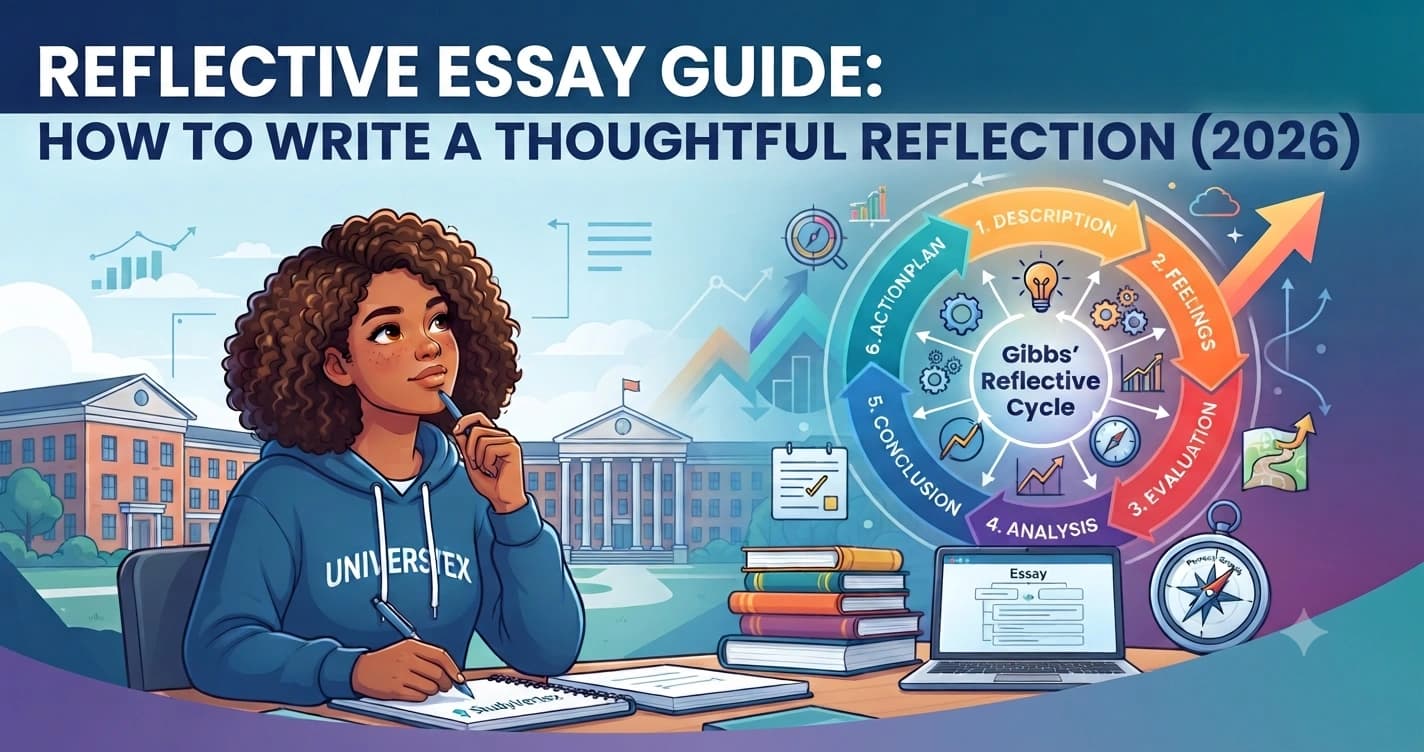
Gibbs' Reflective Cycle
One of the most widely used reflective writing models is Gibbs' Reflective Cycle.
It consists of six stages that help students analyze experiences systematically.
1. Description
Explain what happened.
Answer:
- What occurred?
- Who was involved?
- Where did it happen?
Avoid unnecessary detail.
2. Feelings
Describe your thoughts and emotions.
Consider:
- How did you feel?
- What were your initial reactions?
- Did your feelings change afterward?
Reflection becomes more meaningful when emotions are explained honestly.
3. Evaluation
Discuss what went well and what didn't.
Examples:
- Successful teamwork
- Poor communication
- Effective planning
- Unexpected challenges
Evaluate both positive and negative aspects objectively.
4. Analysis
Explain why events happened.
Ask yourself:
- What caused the outcome?
- What theories or concepts relate to this experience?
- Could anything have been handled differently?
This section demonstrates critical thinking.
5. Conclusion
Summarize the key lesson.
Explain:
- What did you learn?
- What skills improved?
- What knowledge did you gain?
Avoid introducing new information here.
6. Action Plan
Describe what you'll do differently in future situations.
For example:
- Improve communication skills.
- Prepare earlier.
- Manage time more effectively.
- Seek additional feedback.
Action plans show continuous learning and personal development.
Kolb's Reflective Learning Cycle
Another popular reflective framework is Kolb's Learning Cycle.
Many universities recommend this model for professional courses such as education, healthcare, nursing, engineering, and business.
Kolb's model includes four stages:
- Concrete Experience
- Reflective Observation
- Abstract Conceptualization
- Active Experimentation
This framework encourages students to apply lessons learned from one experience to future situations.
Choosing the Right Experience
Not every experience makes a good reflective essay topic.
Choose an experience that:
- Changed your perspective.
- Helped you develop new skills.
- Presented meaningful challenges.
- Encouraged personal growth.
- Allowed thoughtful analysis.
Examples include:
- First university presentation
- Internship experience
- Clinical placement
- Volunteer work
- Leadership project
- Group assignment
- Research project
- Public speaking experience
- Study abroad program
- Learning a new skill
Meaningful experiences usually produce stronger reflections.
Standard Reflective Essay Structure
Most university reflective essays follow this structure:
Introduction
Your introduction should:
- Introduce the experience.
- Explain its importance.
- Briefly state what readers will learn from your reflection.
Avoid revealing every detail immediately.
Instead, encourage readers to continue reading.
Pro Tip: Before writing your essay, create two lists—one describing what happened and another explaining what you learned. Separating facts from reflections helps you maintain the right balance between storytelling and critical analysis.
Writing the Body Paragraphs
The body paragraphs are where you move beyond describing an experience and begin analyzing it. This is where lecturers assess your critical thinking, self-awareness, and ability to apply learning.
Each body paragraph should focus on one key stage of your experience.
Describe the Experience
Begin by explaining the situation clearly.
Answer questions like:
- What happened?
- Where did it happen?
- Who was involved?
- What role did you play?
Keep your description brief and focused.
Remember, reflective essays are not autobiographies.
Example:
During my second semester at university, I participated in a group research project that required four students to work together over six weeks. Although everyone contributed different ideas, communication problems quickly created disagreements within the team.
Explain Your Feelings
Reflection requires honesty.
Discuss your emotions before, during, and after the experience.
For example:
Initially, I felt confident because I had previous experience working on group assignments. However, as deadlines approached and communication became inconsistent, I became frustrated and uncertain about whether we would complete the project successfully.
Explaining emotions helps readers understand your perspective.
Analyze the Experience
This is often the highest-scoring section of a reflective essay.
Instead of asking:
"What happened?"
Ask:
- Why did it happen?
- What contributed to the outcome?
- What did I do well?
- What mistakes did I make?
- What theories or concepts explain this experience?
Example:
Looking back, I realized that our team lacked clear role allocation during the early stages of the project. This resulted in duplicated work and confusion regarding responsibilities. Better planning and regular communication could have prevented many of these issues.
Analysis demonstrates critical thinking rather than simple storytelling.
Connect Learning to Future Practice
Reflection should always move beyond the past.
Ask yourself:
- What have I learned?
- How will this influence my future behaviour?
- What skills have improved?
- What will I do differently next time?
Example:
This experience taught me that successful teamwork depends on early planning and open communication. In future projects, I will ensure responsibilities are clearly assigned from the beginning and schedule regular progress meetings to avoid misunderstandings.
This demonstrates continuous personal development.
Reflective Essay Example Outline
Topic
My First University Group Project
Introduction
- Introduce the assignment
- Explain why the experience was significant
- State the purpose of the reflection
Body Paragraph One
Describe the project
Initial expectations
First impressions
Body Paragraph Two
Challenges faced
Communication problems
Time management
Emotional responses
Body Paragraph Three
Lessons learned
Improved teamwork
Personal development
Future improvements
Conclusion
Summarize the experience
Reflect on overall learning
Explain how it will influence future academic work
Creating an outline before writing makes your reflection more organized and coherent.
Common Reflective Essay Mistakes
Avoid these common errors to improve your academic writing.
Only Describing Events
Many students spend the entire essay explaining what happened.
Reflection requires analysis.
Always explain:
- Why the experience mattered.
- What you learned.
- How it changed your thinking.
Being Too Emotional
Reflection should remain balanced.
Avoid exaggerated emotional language.
Instead of writing:
It was the worst experience of my life.
Write:
The experience was challenging because I struggled to communicate effectively with my team members, but it helped me recognize the importance of leadership and collaboration.
Maintain an academic tone.
Ignoring Personal Development
Your lecturer wants to see growth.
Always explain:
- Skills gained
- Knowledge developed
- Future improvements
Without reflection, the essay becomes a simple narrative.
Weak Organization
Jumping randomly between events makes essays difficult to follow.
Present experiences logically.
Use clear transitions between paragraphs.
No Connection to Learning
Reflection isn't only about describing experiences.
Explain how the experience connects with academic theories, professional skills, or future situations whenever appropriate.
Tips for Writing Better Reflective Essays
Use these practical strategies to strengthen your reflection.
✔ Choose a meaningful experience.
✔ Focus on learning rather than storytelling.
✔ Use honest self-evaluation.
✔ Explain both successes and mistakes.
✔ Support reflection with examples.
✔ Connect learning to future situations.
✔ Maintain an academic writing style.
✔ Revise carefully before submission.
Reflective writing improves significantly with regular practice.
Final Reflective Essay Checklist
Before submitting your essay, review this checklist.
Planning
☐ Selected a meaningful experience
☐ Identified the lesson learned
☐ Created an outline
Writing
☐ Strong introduction
☐ Clear description
☐ Honest reflection
☐ Critical analysis
☐ Future action plan
☐ Strong conclusion
Editing
☐ Grammar checked
☐ Paragraphs organized
☐ Academic tone maintained
☐ Word count confirmed
☐ Proofread carefully
Following this checklist improves both readability and academic quality.
Frequently Asked Questions
What is the purpose of a reflective essay?
A reflective essay helps students analyze personal experiences, evaluate their learning, and demonstrate critical thinking while explaining how an experience contributed to personal or academic development.
Can I use first-person pronouns?
Yes.
Reflective essays are normally written using first-person language such as I, me, and my, unless your instructor specifies otherwise.
Do reflective essays need references?
Some university assignments require academic references that connect personal experiences with theories or research, while others focus primarily on personal reflection.
Always follow your assignment guidelines.
What is the best reflective model?
The two most common reflective models are:
- Gibbs' Reflective Cycle
- Kolb's Reflective Learning Cycle
Your instructor may recommend one depending on your course.
How long should a reflective essay be?
Most university reflective essays range between 1,000 and 2,500 words, although requirements vary by assignment.
For more academic writing support, explore these StudyVertex guides:
Related StudyVertex Guides
Continue improving your academic writing with these resources:
- Complete Essay Writing Guide
- How to Write an Essay
- Essay Structure Explained
- Essay Introduction Examples
- Argumentative Essay Guide
- Narrative Essay Guide
- Grammarly for Academic Writing
- AI Prompt Guide for Students
Final Thoughts
Reflective essays are an opportunity to demonstrate much more than your writing ability—they show your capacity for self-awareness, critical thinking, and continuous improvement. A well-written reflection goes beyond describing events by explaining why those experiences mattered, what lessons were learned, and how they will influence your future decisions.
Whether you're reflecting on a classroom presentation, internship, clinical placement, research project, or personal challenge, focus on thoughtful analysis rather than simply recounting events. Honest reflection, combined with clear organization and meaningful insights, will help you produce stronger academic work and develop valuable lifelong learning skills.
Need Help Writing a Reflective Essay?
Writing a reflective essay can be challenging, especially when you're expected to combine personal experiences with critical analysis and academic writing standards. If you need help planning, structuring, editing, or refining your reflection, StudyVertex is here to help.
Our experienced academic experts provide personalized support to help students create well-structured, original, and insightful reflective essays while meeting university requirements.
Explore our Essay Writing Service for professional academic assistance.
You may also find these services helpful:
At StudyVertex, we're committed to helping students develop stronger reflective writing skills, think critically about their experiences, and achieve lasting academic success.