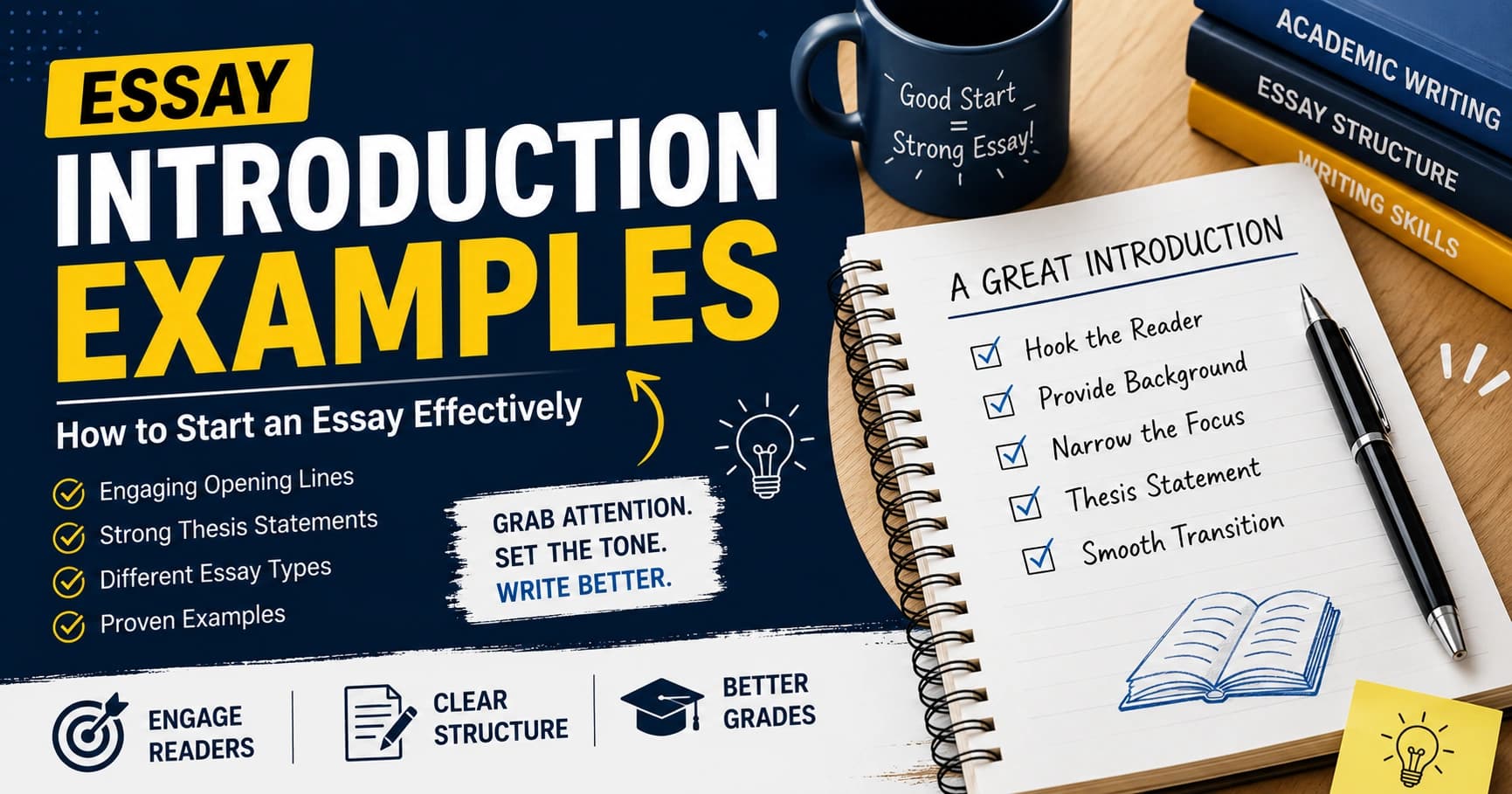
Learn how to grab your reader's attention and write essay introductions that make a strong first impression.
The introduction is one of the most important parts of an academic essay. It is the first section your professor reads, and it sets the tone for everything that follows. A well-written introduction immediately tells the reader what your essay is about, why the topic matters, and what argument you will present.
Unfortunately, many students struggle with writing introductions. Some begin with generic statements, while others provide too much background information or reveal their conclusion before the discussion even starts. These mistakes can make an essay feel unorganized before the main argument has even begun.
The good news is that writing an effective introduction is a skill that anyone can learn. Once you understand its purpose and follow a simple structure, creating strong opening paragraphs becomes much easier.
In this guide, you'll learn how to write an engaging essay introduction, understand the key elements of a successful opening paragraph, and explore practical essay introduction examples that you can use as inspiration for your own assignments.
If you're completely new to essay writing, start with our How to Write an Essay guide. For a complete overview of planning, researching, structuring, and editing academic essays, visit our Complete Essay Writing Guide.
Students looking for expert guidance with academic writing can also explore our Essay Writing Service for personalized support.
Quick Essay Introduction Checklist
Before moving to the body paragraphs, make sure your introduction includes:
☐ An engaging opening sentence
☐ Relevant background information
☐ Clear context for the topic
☐ A focused thesis statement
☐ A smooth transition into the main discussion
A strong introduction encourages readers to continue while clearly presenting your essay's purpose.
Article Overview
Category: Essay Writing
Updated: July 2026
Reading Time: 12–14 Minutes
Author: StudyVertex Academic Team
Table of Contents
- What Is an Essay Introduction?
- Why the Introduction Matters
- The Four Parts of a Great Essay Introduction
- How to Start an Essay
- Essay Introduction Examples
- Strong vs Weak Introductions
- Common Introduction Mistakes
- Tips for Better Introductions
- FAQs
- Final Thoughts
What Is an Essay Introduction?
An essay introduction is the opening section of an academic essay. Its purpose is to introduce the topic, provide background information, and prepare readers for the discussion that follows.
A good introduction answers three important questions:
- What is the essay about?
- Why is this topic important?
- What argument or point will the essay make?
Rather than presenting detailed evidence, the introduction provides readers with a clear overview of the essay before moving into the main discussion.
Think of your introduction as a roadmap. It tells readers where your essay is heading and what they should expect in the following sections.
Why the Introduction Matters
Many students underestimate the importance of the introduction, but it plays a significant role in creating a positive first impression.
A strong introduction helps you:
Capture the Reader's Attention
An interesting opening encourages readers to continue reading your essay.
Instead of beginning with a dictionary definition or an obvious statement, try introducing the topic with a surprising fact, a thought-provoking question, or a relevant observation.
Provide Context
Readers need enough background information to understand why the topic matters.
Your introduction should briefly explain the issue without discussing every detail.
Save detailed explanations for the body paragraphs.
Present a Clear Thesis Statement
The thesis statement is the heart of your introduction.
It tells readers exactly what your essay will argue, explain, or analyze.
Every body paragraph should support this central idea.
Create a Logical Transition
A well-written introduction naturally leads readers into the first body paragraph.
This smooth transition improves readability and makes your essay feel organized.
The Four Parts of a Great Essay Introduction
Almost every successful academic introduction follows the same basic structure.
Part 1: Hook
The hook is the opening sentence that captures the reader's attention.
Common types of hooks include:
- Interesting facts
- Statistics
- Questions
- Short anecdotes
- Famous quotations
- Real-world observations
Example
Artificial Intelligence is changing the way millions of students learn, research, and complete academic assignments.
This opening immediately introduces the topic without overwhelming the reader.
Part 2: Background Information
After the hook, provide enough context to explain the topic.
For example, if your essay discusses online education, briefly explain how digital learning has evolved and why it is important.
Avoid giving excessive detail at this stage.
The goal is simply to prepare readers for your discussion.
Part 3: Narrow the Focus
Move from the general topic toward the specific issue your essay will discuss.
This transition helps readers understand exactly what aspect of the topic your essay will explore.
For example:
Instead of discussing education in general, narrow your focus to AI tools, online learning, or student productivity.
Part 4: Thesis Statement
Finish your introduction with a clear thesis statement.
The thesis communicates your main argument in one or two sentences.
Weak Thesis
Technology is useful for students.
This statement is too broad.
Strong Thesis
Artificial Intelligence is transforming higher education by improving research, increasing learning efficiency, and supporting personalized education, although responsible use remains essential.
Notice how the second example clearly communicates the direction of the essay.
How to Start an Essay
Many students spend more time writing the first sentence than any other part of the essay.
Fortunately, you don't need to write the perfect opening immediately.
Here are five effective ways to begin an academic essay.
Start with a Surprising Fact
Interesting facts quickly capture attention.
Example:
More than half of university students regularly use digital learning tools to support their academic work.
Ask a Thought-Provoking Question
Questions encourage readers to think about the topic.
Example:
Can Artificial Intelligence improve learning without replacing critical thinking?
Begin with a Brief Observation
Observations make introductions feel natural.
Example:
University education has changed dramatically over the last decade as digital technologies become increasingly integrated into classrooms.
Use a Relevant Statistic
Statistics immediately establish importance.
Example:
Millions of students now rely on online educational platforms for research and independent learning.
Remember to cite reliable academic sources in your final essay.
Introduce a Real-World Situation
Connecting your topic to everyday life helps readers understand its relevance.
Example:
From completing assignments to preparing presentations, university students use digital tools more frequently than ever before.
This creates an engaging transition into your discussion.
Pro Tip: Don't spend too much time perfecting your introduction before writing the body of your essay. Many experienced writers draft the introduction first, complete the essay, and then return to revise the opening so it accurately reflects the final discussion.
Step 6: Develop Strong Body Paragraphs
The body paragraphs are the foundation of your essay. This is where you explain your ideas, present evidence, analyze information, and convince the reader that your argument is valid.
Each paragraph should focus on one main idea. Avoid discussing multiple unrelated points in the same paragraph, as this can confuse readers and weaken your argument.
A simple and effective way to structure body paragraphs is by using the PEEL method.
P – Point
Begin the paragraph with a clear topic sentence that introduces the main idea.
Example:
Artificial Intelligence has significantly improved personalized learning in higher education.
E – Evidence
Support your point using reliable academic sources.
Evidence can include:
- Research findings
- Statistics
- Journal articles
- Books
- Expert opinions
- Real-world examples
Always use credible sources instead of unsupported opinions.
E – Explanation
Explain why the evidence is important.
Connect it to your main argument.
This is where critical thinking becomes important.
Instead of simply presenting a statistic, explain:
- What does it mean?
- Why is it important?
- How does it support your thesis?
L – Link
Finish the paragraph by linking it back to your thesis statement and smoothly transitioning to the next paragraph.
This creates a logical flow throughout the essay.
Example Body Paragraph
Topic Sentence
Artificial Intelligence has improved learning by providing personalized educational experiences.
Evidence
Many universities now use AI-powered learning platforms that adapt study materials according to student performance.
Explanation
These systems help students learn at their own pace while identifying knowledge gaps more efficiently than traditional teaching methods.
Link
As AI technology continues to evolve, personalized learning is expected to become an even more important part of higher education.
Step 7: Write a Strong Conclusion
The conclusion is your final opportunity to leave a positive impression on the reader.
A strong conclusion should summarize your discussion without introducing new information.
Your conclusion should include:
- Restate the thesis.
- Summarize the main arguments.
- Highlight the importance of the discussion.
- End with a meaningful closing thought.
Example Conclusion Structure
Restate the topic
↓
Summarize the key arguments
↓
Reinforce your thesis
↓
Provide a final recommendation or insight
Avoid repeating sentences word for word from the introduction.
Instead, paraphrase your ideas while reinforcing the central message of your essay.
Edit and Proofread Your Essay
Many students lose marks because they submit their first draft without reviewing it.
Editing helps improve:
- Grammar
- Sentence structure
- Paragraph flow
- Word choice
- Clarity
- Academic tone
Proofreading should always be the final step before submission.
A useful editing checklist includes:
✔ Correct grammar mistakes
✔ Remove unnecessary repetition
✔ Improve sentence flow
✔ Verify references
✔ Check formatting
✔ Confirm the word count
✔ Ensure all paragraphs support the thesis
You can also improve clarity using writing tools. Read our guide on Grammarly for Academic Writing to learn how AI-assisted proofreading can strengthen your writing while maintaining originality.
Common Essay Writing Mistakes
Understanding common mistakes can help you avoid losing valuable marks.
Misunderstanding the Essay Question
Many students start researching before fully understanding the assignment requirements.
Always identify:
- Topic
- Essay type
- Word count
- Assessment criteria
- Referencing style
Weak Thesis Statement
A vague thesis makes your essay feel unfocused.
Your thesis should clearly communicate your main argument and guide every section of your essay.
Poor Organization
Jumping between unrelated ideas makes essays difficult to follow.
Every paragraph should focus on one idea and connect logically to the next.
Lack of Evidence
Strong academic writing is based on reliable research.
Support every major point with:
- Academic journals
- Books
- Government reports
- Research papers
- Credible statistics
Ignoring Citations
Improper referencing may result in plagiarism and academic penalties.
Always keep track of your sources from the beginning of your research.
Skipping Proofreading
Even excellent essays can lose marks due to avoidable grammar or formatting mistakes.
Always leave enough time to review your work before submission.
Essay Writing Tips for Better Grades
Improving your essays doesn't require complicated techniques. Small improvements can make a significant difference over time.
- Understand the assignment before writing.
- Create a simple outline.
- Research reliable academic sources.
- Write one idea per paragraph.
- Use clear topic sentences.
- Support arguments with evidence.
- Keep paragraphs focused.
- Use transition words for better flow.
- Edit and proofread carefully.
- Follow your university's formatting guidelines.
Consistency is more important than trying to write the perfect first draft.
Final Essay Writing Checklist
Before submitting your essay, complete this checklist.
Planning
☐ Read the assignment question carefully
☐ Created an essay outline
☐ Collected reliable academic sources
☐ Developed a clear thesis statement
Writing
☐ Strong introduction
☐ Logical body paragraphs
☐ Evidence supports every argument
☐ Smooth transitions between paragraphs
☐ Clear conclusion
Editing
☐ Grammar checked
☐ Spelling reviewed
☐ References verified
☐ Formatting completed
☐ Word count confirmed
Using a checklist like this helps ensure your essay is polished and submission-ready.
Frequently Asked Questions
How long should an academic essay be?
The required length depends on your assignment guidelines. Always follow your instructor's word count while ensuring every section contributes meaningfully to your argument.
What is the most important part of an essay?
Every section is important, but a strong thesis statement and well-developed body paragraphs usually have the greatest impact because they present and support your main argument.
How can I improve my essay writing?
Practice regularly, read academic sources, plan your essays carefully, seek feedback, and proofread every draft before submission.
Can AI help with essay writing?
AI tools can assist with brainstorming, outlining, grammar checking, and improving clarity. However, your final submission should reflect your own understanding and comply with your institution's academic integrity policies.
Learn more in our guides:
Related StudyVertex Guides
Continue improving your academic writing with these resources:
- The Complete Essay Writing Guide
- Grammarly for Academic Writing
- AI Prompt Guide for Students
- Perplexity AI for Research
- ChatGPT for Students
- Google Gemini for Students
Final Thoughts
Learning how to write an essay is one of the most valuable academic skills you can develop. A well-written essay demonstrates your ability to research, analyze information, think critically, and communicate ideas effectively.
By understanding the assignment, planning your structure, developing a clear thesis statement, supporting your arguments with evidence, and carefully proofreading your work, you can produce essays that are organized, persuasive, and academically sound.
Remember that strong essays are rarely written in a single sitting. Planning, revising, and refining your work are essential steps that help transform a first draft into a high-quality academic submission.
Need Help with Your Essay?
Writing an excellent essay requires time, research, critical thinking, and attention to detail. If you need support with planning, structuring, editing, or refining your academic work, StudyVertex is here to help.
Our experts provide personalized guidance to help students improve their writing skills while meeting university expectations.
Explore our Essay Writing Service for professional academic support.
You may also find these services helpful:
At StudyVertex, we're committed to helping students learn smarter, write better, and achieve academic success with confidence.
Free Student Tools
While you're here, two free tools that might save you some time:
- GPA Calculator — instantly calculate your semester or cumulative GPA, no sign-up required.
- Citation Generator — generate accurate APA, MLA, or IEEE citations in seconds.