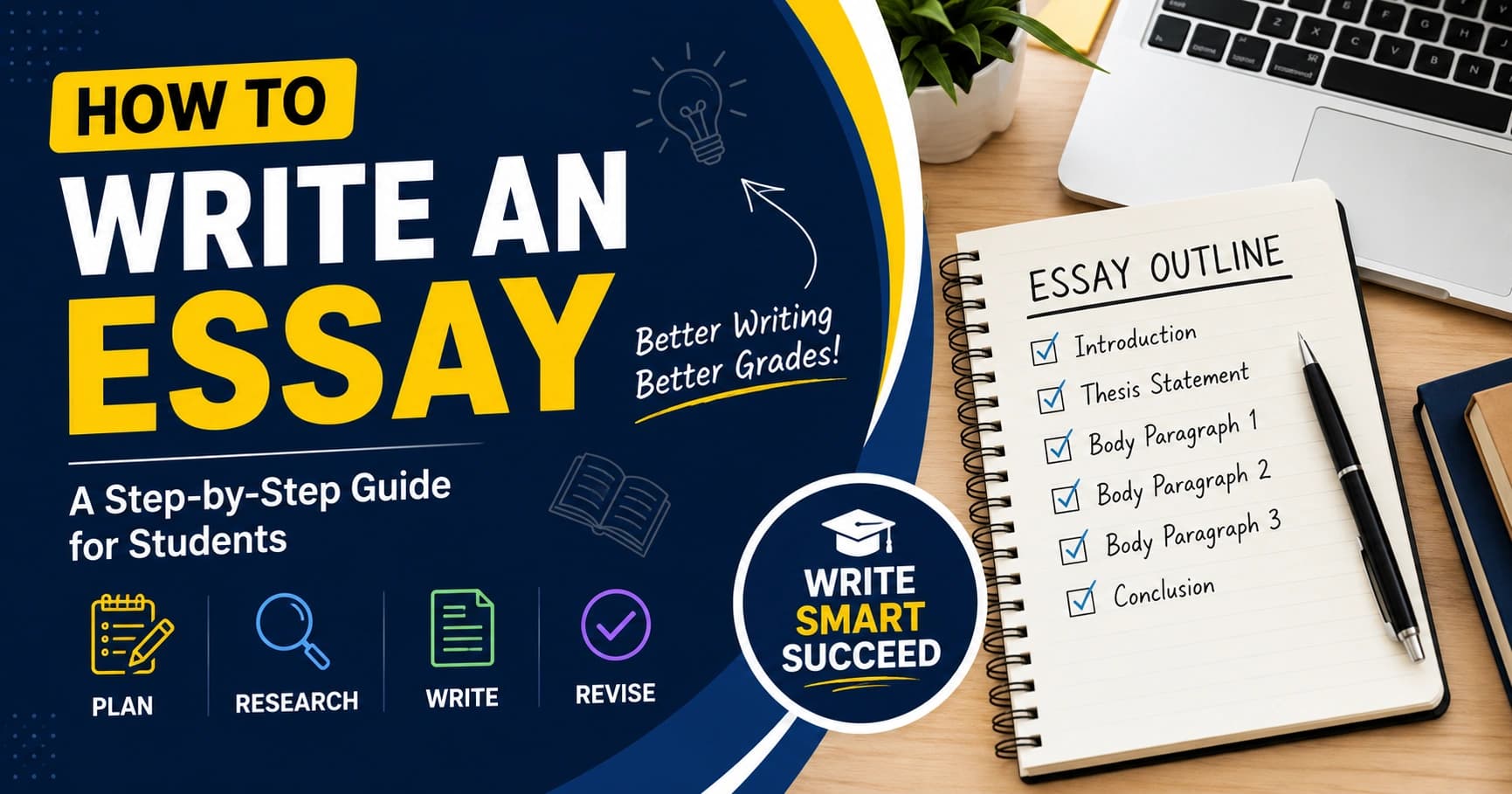
Learn smarter. Write confidently. Achieve better academic results.
Essay writing is one of the most important academic skills every student needs to develop. Whether you're in high school, college, or university, essays are used to assess your understanding of a topic, your ability to research information, and your critical thinking skills.
Despite writing multiple essays throughout their academic journey, many students still struggle with planning, structuring, researching, and presenting their ideas effectively. Common challenges include understanding essay questions, developing strong arguments, organizing paragraphs, and following academic writing standards.
The good news is that essay writing is a skill that improves with practice and the right guidance. Once you understand the process, writing an essay becomes far less stressful and much more organized.
This complete guide will walk you through every stage of essay writing—from understanding the question to researching reliable sources, creating a strong thesis statement, writing engaging introductions, developing convincing body paragraphs, and finishing with an effective conclusion.
Whether you're writing an argumentative essay, analytical essay, persuasive essay, descriptive essay, or reflective essay, the techniques shared in this guide will help you write with greater confidence and clarity.
If you're looking for professional academic support while improving your writing skills, you can also explore our Essay Writing Service for personalized guidance.
You may also find these StudyVertex resources helpful:
- AI Prompt Guide for Students
- Grammarly for Academic Writing
- ChatGPT for Students
- Google Gemini for Students
- Assignment Help
Together, these guides will help you strengthen your academic writing, research, and study skills.
Quick Essay Writing Checklist
Before submitting your essay, ask yourself:
☐ Did I fully understand the essay question?
☐ Is my thesis statement clear?
☐ Did I research reliable academic sources?
☐ Does my essay have a logical structure?
☐ Does each paragraph support my main argument?
☐ Did I include evidence and examples?
☐ Have I cited all sources correctly?
☐ Did I proofread my grammar and spelling?
☐ Does my conclusion summarize the main points?
☐ Have I followed my university's formatting guidelines?
Completing this checklist before submission can significantly improve the quality of your essay.
Article Overview
Category: Essay Writing
Updated: July 2026
Author: StudyVertex Academic Team
Reading Time: 18–20 Minutes
Table of Contents
- What Is Essay Writing?
- Why Essay Writing Matters
- Different Types of Essays
- Understanding Essay Questions
- How to Plan an Essay
- Essay Structure Explained
- Researching Reliable Sources
- Writing a Strong Thesis Statement
- Writing an Engaging Introduction
- Writing Effective Body Paragraphs
- Writing a Powerful Conclusion
- Referencing and Citations
- Common Essay Writing Mistakes
- Essay Writing Tips
- Essay Writing Checklist
- Frequently Asked Questions
- Conclusion
What Is Essay Writing?
Essay writing is the process of presenting ideas, arguments, and evidence in a clear, logical, and structured manner to answer a specific question or discuss a particular topic.
Unlike casual writing, academic essays require students to research information, analyze evidence, evaluate different viewpoints, and communicate ideas using formal language.
A well-written essay doesn't simply describe information—it explains, evaluates, and supports arguments with credible evidence.
Most academic essays aim to demonstrate a student's ability to:
- Understand a topic thoroughly
- Research reliable information
- Analyze evidence critically
- Organize ideas logically
- Present arguments clearly
- Follow academic writing standards
Developing these skills not only improves grades but also prepares students for professional communication in their future careers.
Why Essay Writing Matters
Essay writing is more than just another university assignment. It helps students build valuable skills that are useful throughout their academic and professional lives.
Develops Critical Thinking
Writing an essay encourages students to examine different viewpoints rather than simply accepting information at face value.
Strong essays answer questions like:
- Why is this important?
- What evidence supports this argument?
- Are there alternative perspectives?
- What conclusions can be drawn?
These questions develop analytical thinking, which is highly valued in higher education and the workplace.
Improves Research Skills
Every quality essay begins with thorough research.
Students learn how to:
- Find reliable academic sources
- Evaluate the credibility of information
- Compare different viewpoints
- Support arguments with evidence
These research skills are essential for dissertations, research papers, and professional reports.
Enhances Communication
Writing teaches students how to express complex ideas clearly and logically.
A strong essay communicates information in a way that is:
- Easy to understand
- Well organized
- Persuasive
- Evidence-based
- Academically appropriate
These communication skills are valuable in almost every profession.
Prepares Students for Future Assessments
Many university assessments follow similar academic writing principles.
Learning how to write essays effectively makes it easier to complete:
- Research papers
- Case studies
- Literature reviews
- Reports
- Dissertations
- Reflective assignments
Strong essay-writing skills provide a foundation for success across different types of academic work.
Different Types of Essays
Not all essays have the same purpose. Understanding the type of essay you're writing is the first step toward meeting your instructor's expectations.
Argumentative Essay
An argumentative essay presents a clear position on a topic and supports it with evidence and logical reasoning.
Students are expected to:
- Develop a strong thesis statement
- Present supporting evidence
- Address opposing viewpoints
- Reach a logical conclusion
Example topics include:
- Should artificial intelligence replace traditional classrooms?
- Is remote work more productive than office work?
- Should governments regulate social media?
Descriptive Essay
A descriptive essay focuses on describing a person, place, object, or experience in vivid detail.
The goal is to help readers visualize the subject through carefully chosen language and sensory details.
Although descriptive essays are less common at university level, they help students improve observation and writing skills.
Narrative Essay
A narrative essay tells a story based on personal experience or a specific event.
Unlike fictional stories, academic narrative essays usually focus on reflection and learning outcomes rather than entertainment.
A strong narrative essay includes:
- A clear sequence of events
- Personal reflection
- Meaningful lessons
- Logical organization
Expository Essay
An expository essay explains a topic objectively using facts and evidence.
Instead of expressing opinions, the writer focuses on informing readers.
Examples include:
- Explaining climate change
- Describing blockchain technology
- Discussing digital marketing strategies
Clarity and logical organization are essential in expository writing.
Persuasive Essay
A persuasive essay aims to convince readers to accept a particular viewpoint.
While similar to an argumentative essay, persuasive writing often appeals to both logic and emotion.
Writers use:
- Strong evidence
- Real-world examples
- Logical reasoning
- Persuasive language
to strengthen their arguments.
Analytical Essay
Analytical essays require students to examine and interpret information rather than simply describe it.
Students may analyze:
- Literature
- Historical events
- Research findings
- Business cases
- Scientific theories
Analytical writing emphasizes evaluation, interpretation, and evidence-based conclusions.
Understanding the purpose of each essay type helps you choose the appropriate structure, tone, and writing style. Before you begin writing, always review your assignment brief carefully to identify exactly what your instructor expects.
Pro Tip: One of the biggest reasons students lose marks is misunderstanding the essay type or the command words in the assignment question. Spending a few extra minutes analyzing the requirements before writing can save hours of revisions later.
Understanding the Essay Question
Before you begin researching or writing, take time to understand exactly what your instructor is asking.
Many students lose marks not because they lack knowledge, but because they answer the wrong question.
Read the assignment brief carefully and identify the following:
- The main topic
- The essay type
- Word count
- Referencing style
- Submission guidelines
- Assessment criteria
Pay close attention to command words such as:
| Command Word | What It Means | |--------------|---------------| | Analyze | Examine different parts and explain relationships. | | Compare | Identify similarities and differences. | | Contrast | Focus mainly on differences. | | Discuss | Present different viewpoints before reaching a conclusion. | | Evaluate | Assess strengths, weaknesses, and overall value. | | Explain | Clarify how or why something happens. | | Justify | Support your opinion with evidence. | | Critically Analyze | Present balanced arguments supported by research. |
Understanding these command words helps you write exactly what your professor expects.
How to Plan an Essay
Planning is one of the most overlooked stages of essay writing, yet it often determines the quality of the final submission.
Students who spend 20–30 minutes planning usually write more organized essays than those who begin writing immediately.
A good essay plan should include:
- Essay topic
- Main argument
- Supporting points
- Research sources
- Examples
- Conclusion ideas
Example Essay Plan
Topic
The Impact of Artificial Intelligence on Higher Education
Introduction
- Background
- Importance of AI
- Thesis statement
Body Paragraph 1
Benefits of AI
- Personalized learning
- Faster feedback
- Productivity
Body Paragraph 2
Challenges
- Academic integrity
- Bias
- Privacy
Body Paragraph 3
Future of AI
- Adaptive learning
- Virtual tutors
- Skill development
Conclusion
Summarize arguments and provide recommendations.
Creating a roadmap before writing makes the process much easier.
The Standard Essay Structure
Most academic essays follow a simple structure.
Introduction
Explain the topic.
Provide background information.
Present your thesis statement.
Outline what readers will learn.
Body Paragraphs
Present one main idea per paragraph.
Support each idea with:
- Evidence
- Examples
- Statistics
- Research
- Academic references
Every paragraph should connect back to your thesis.
Conclusion
Summarize the discussion.
Do not introduce new information.
Finish with a meaningful final thought or recommendation.
Following this structure improves readability and helps your ideas flow naturally.
If you're finding it difficult to organize your ideas, our Essay Writing Service can help you develop a clear structure while maintaining academic standards.
How to Research for an Essay
Strong essays are built on reliable evidence rather than personal opinions.
Good research helps you:
- Build stronger arguments
- Support your claims
- Increase credibility
- Demonstrate academic understanding
Use trustworthy sources such as:
- Peer-reviewed journals
- University textbooks
- Government publications
- Academic databases
- Reputable research organizations
Avoid relying solely on:
- Random blogs
- Anonymous websites
- Unverified social media posts
- Outdated sources
Always verify information before including it in your essay.
Students conducting extensive academic research may also benefit from our guide on Perplexity AI for Research, which explains how AI tools can support literature reviews and source discovery responsibly.
Organizing Your Research
As you gather information, keep your notes organized.
A simple research table can save hours during the writing process.
| Source | Main Idea | Evidence | Citation | |---------|-----------|----------|----------| | Journal Article | AI improves learning efficiency | Statistics | APA | | Government Report | Digital education growth | Survey data | Harvard | | Research Paper | Student engagement | Case study | MLA |
Keeping track of your sources from the beginning prevents citation errors later.
How to Write a Strong Thesis Statement
The thesis statement is the foundation of your essay.
It tells readers what your essay will argue or explain.
A weak thesis makes the entire essay feel unfocused.
Weak Thesis
Artificial Intelligence is becoming popular.
This statement is too broad.
Strong Thesis
Artificial Intelligence is transforming higher education by improving personalized learning, increasing student productivity, and supporting research, although ethical concerns regarding academic integrity must also be addressed.
The second example clearly states:
- Topic
- Main argument
- Supporting ideas
Every body paragraph should support this thesis.
Characteristics of a Good Thesis Statement
A strong thesis should be:
- Clear
- Specific
- Debatable (when appropriate)
- Relevant
- Focused
- Concise
Avoid writing vague statements that fail to communicate your main argument.
How to Write an Engaging Introduction
Your introduction creates the reader's first impression.
A strong introduction encourages readers to continue.
A typical introduction includes four parts.
1. Opening Sentence
Begin with an interesting fact, statistic, question, or observation.
Example:
Artificial Intelligence is rapidly changing how students learn, research, and complete academic work.
2. Background Information
Provide context.
Explain why the topic is important.
Avoid giving excessive detail.
3. Narrow the Focus
Gradually move from the general topic toward your specific discussion.
This transition prepares readers for your argument.
4. Thesis Statement
End the introduction with a clear thesis statement.
This tells readers exactly what your essay will discuss.
Example Introduction Structure
Hook
Interesting statement
↓
Background
Context
↓
Problem
Why the topic matters
↓
Thesis Statement
Main argument
↓
Essay Roadmap
Brief overview of upcoming sections
This structure works well for most university essays.
Writing Effective Body Paragraphs
The body paragraphs are where you develop your ideas and support your thesis.
Each paragraph should focus on one main idea.
A useful framework is the PEEL method.
P — Point
Start with a clear topic sentence.
E — Evidence
Support your point with facts, examples, statistics, or academic research.
E — Explanation
Explain how the evidence supports your argument.
L — Link
Connect the paragraph back to your thesis and transition to the next idea.
Following the PEEL structure helps create logical, coherent paragraphs that are easy to follow and score well in academic assessments.
Pro Tip: Before writing each paragraph, ask yourself: "Does this point directly support my thesis statement?" If the answer is no, consider revising or removing it to keep your essay focused.
Writing a Powerful Essay Conclusion
Many students spend hours perfecting their introduction but rush through the conclusion. A weak ending can reduce the overall impact of an otherwise excellent essay.
A strong conclusion reinforces your argument and leaves the reader with a clear understanding of your key points.
Your conclusion should:
- Restate your thesis in different words.
- Summarize the main arguments.
- Highlight the significance of your discussion.
- End with a meaningful closing statement or recommendation.
Avoid introducing new evidence, statistics, or arguments in the conclusion. Instead, focus on bringing your discussion together in a logical and concise way.
Example Conclusion Structure
Restate the Topic
↓
Summarize Main Arguments
↓
Reinforce the Thesis
↓
Final Thought or Recommendation
Following this structure helps create a professional and memorable conclusion.
Referencing and Citation Styles
Proper referencing is an essential part of academic writing. It acknowledges the original authors, strengthens your arguments, and helps avoid plagiarism.
The citation style you use depends on your university or instructor's guidelines.
The most common styles include:
| Referencing Style | Commonly Used In | |-------------------|------------------| | APA | Psychology, Business, Education | | MLA | Literature and Humanities | | Harvard | Business, Management, Social Sciences | | Chicago | History and Publishing | | IEEE | Engineering and Computer Science |
Always follow your institution's formatting requirements and double-check every citation before submission.
How to Improve Your Essay Writing
Improving your writing is a gradual process that comes with regular practice and constructive feedback.
Here are some practical strategies that successful students use.
Read Academic Sources
Reading journal articles, textbooks, and well-written essays helps you understand academic tone, structure, and vocabulary.
Expand Your Vocabulary
Use precise and formal language instead of informal expressions.
For example:
Instead of:
A lot of students...
Write:
Many university students...
Simple improvements like these make your writing sound more professional.
Practice Regularly
Essay writing improves through consistent practice.
Try writing:
- Short opinion essays
- Literature reviews
- Article summaries
- Research reflections
The more you write, the easier organizing ideas becomes.
Seek Feedback
Ask professors, classmates, or academic mentors to review your essays.
Constructive feedback helps identify:
- Weak arguments
- Grammar mistakes
- Poor paragraph flow
- Missing evidence
- Structural issues
Proofread Carefully
Never submit your first draft.
Review your work for:
- Grammar
- Spelling
- Punctuation
- Formatting
- Referencing
- Consistency
You can also use writing tools to support proofreading. Learn more in our guide to Grammarly for Academic Writing.
Common Essay Writing Mistakes
Even experienced students make mistakes. Recognizing them early can significantly improve your grades.
Not Answering the Question
One of the biggest reasons students lose marks is writing around the topic instead of directly answering the essay question.
Always return to your thesis throughout the essay.
Weak Thesis Statement
A vague thesis leads to an unfocused essay.
Your thesis should clearly communicate the main argument and guide the reader through the discussion.
Poor Structure
Jumping between ideas makes essays difficult to follow.
Ensure every paragraph has:
- One main idea
- Supporting evidence
- Clear explanation
- Logical transition
Lack of Evidence
Academic writing should be supported by credible sources rather than personal opinions alone.
Include:
- Research findings
- Academic journals
- Books
- Government reports
- Reliable statistics
Ignoring Referencing
Missing citations can lead to plagiarism issues and lower marks.
Keep track of every source from the beginning of your research.
Last-Minute Writing
Writing an essay the night before submission often leads to:
- Weak arguments
- Poor grammar
- Missing references
- Formatting errors
Start early and allow enough time for editing.
Essay Writing Tips for Better Grades
Small improvements can make a noticeable difference in your writing quality.
✔ Understand the essay question before researching.
✔ Create a clear outline before writing.
✔ Use reliable academic sources.
✔ Write one idea per paragraph.
✔ Support every argument with evidence.
✔ Use transition words to improve flow.
✔ Avoid unnecessary repetition.
✔ Keep paragraphs focused.
✔ Proofread multiple times.
✔ Follow your university's formatting guidelines.
Consistency matters more than perfection.
Essay Writing Checklist
Before submitting your essay, complete this checklist.
Planning
☐ Understood the assignment question
☐ Identified the essay type
☐ Created an outline
☐ Conducted sufficient research
Writing
☐ Clear introduction
☐ Strong thesis statement
☐ Logical body paragraphs
☐ Evidence supports each argument
☐ Smooth transitions
☐ Effective conclusion
Editing
☐ Grammar checked
☐ Spelling corrected
☐ References verified
☐ Formatting reviewed
☐ Word count confirmed
Using a checklist helps reduce avoidable mistakes before submission.
Frequently Asked Questions
What is the ideal structure of an academic essay?
A standard essay includes an introduction, body paragraphs, and a conclusion. Each section should contribute to answering the essay question logically and clearly.
How long should an essay introduction be?
The introduction typically represents around 10–15% of the total word count. It should introduce the topic, provide context, and present a clear thesis statement.
How many body paragraphs should an essay have?
This depends on the required word count, but most university essays contain three to five well-developed body paragraphs.
Can I use AI tools while writing essays?
AI tools can assist with brainstorming, outlining, grammar checks, and improving clarity. However, students should always verify information, follow university policies, and ensure their final work reflects their own understanding.
For responsible AI usage, read our guides:
How can I improve my essay writing?
Regular practice, reading academic sources, planning before writing, seeking feedback, and proofreading carefully are some of the most effective ways to improve.
Related StudyVertex Guides
Continue building your academic writing skills with these helpful resources:
- AI Prompt Guide for Students
- Grammarly for Academic Writing
- ChatGPT for Students
- Google Gemini for Students
- Perplexity AI for Research
- AI Assignment Writing Guide
- Can Universities Detect AI?
Final Thoughts
Essay writing is a skill that develops through practice, careful planning, and continuous improvement. While the process may seem challenging at first, following a structured approach makes it much more manageable.
By understanding the essay question, conducting reliable research, creating a clear outline, developing a strong thesis statement, organizing logical paragraphs, and proofreading thoroughly, you can produce essays that are both academically sound and engaging to read.
Remember that great essays are rarely written in a single draft. Planning, revising, and refining your work are just as important as the writing itself.
The strategies shared in this guide will help you become a more confident writer and prepare you for a wide range of academic assignments throughout your educational journey.
Need Expert Help with Your Essays?
Writing a high-quality essay takes time, research, critical thinking, and careful editing. If you need guidance with planning, structuring, referencing, or refining your academic work, StudyVertex is here to help.
Our experienced academic experts provide personalized support across a wide range of subjects while helping students strengthen their writing skills and meet university standards.
Explore our Essay Writing Service to learn how we can support your academic success.
You may also be interested in:
At StudyVertex, our mission is to help students learn smarter, write better, and achieve academic excellence with confidence.