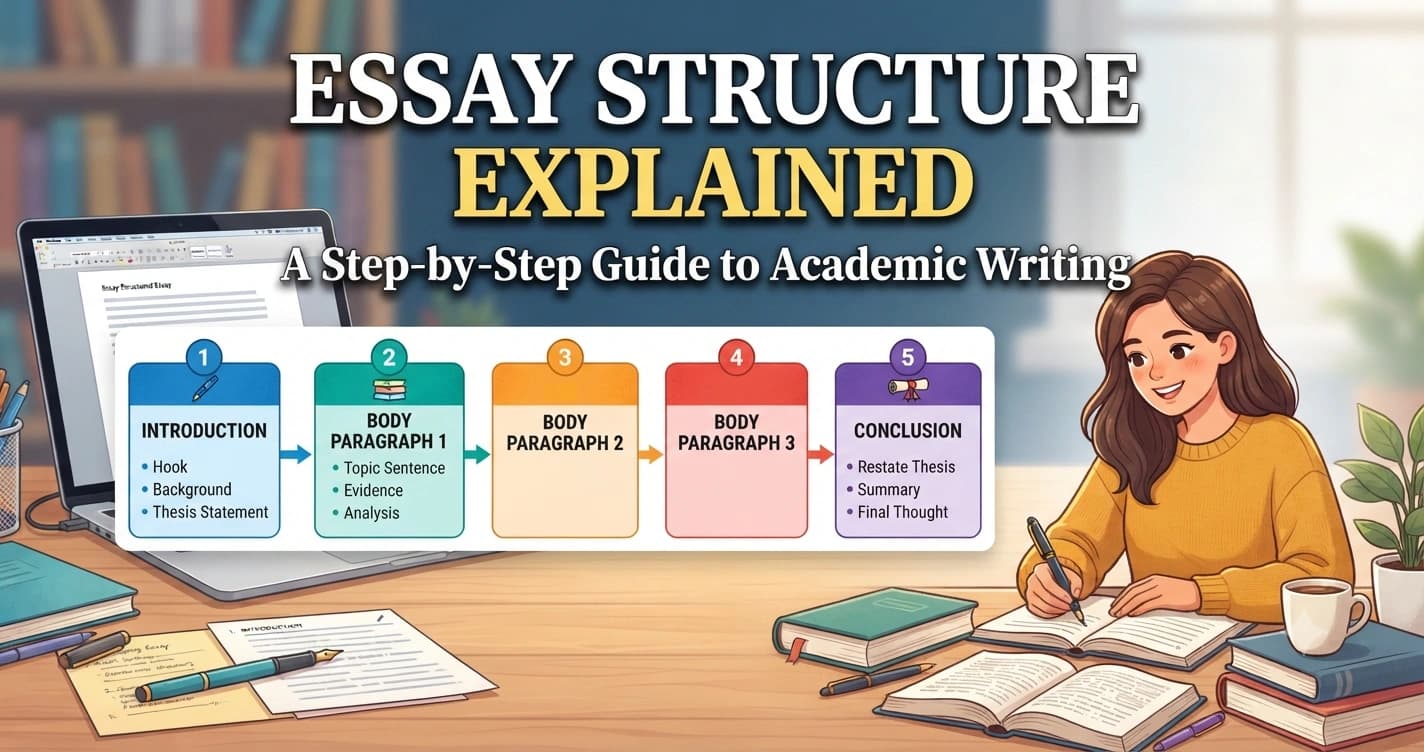
Build stronger essays with a clear structure that improves readability, strengthens arguments, and helps you score higher grades.
Many students lose marks not because they lack knowledge of the subject, but because their essays are poorly organized. Even excellent research and strong arguments can fail to impress if ideas are presented in a confusing or unstructured way.
Understanding essay structure is one of the most important academic writing skills you can develop. A well-structured essay guides the reader from one idea to the next, making your arguments easier to understand and more convincing.
Whether you're writing an argumentative essay, analytical essay, persuasive essay, descriptive essay, or reflective assignment, the basic structure remains largely the same. Once you understand this framework, you can confidently approach almost any academic writing task.
In this guide, you'll learn how to structure an essay from beginning to end. We'll explain the purpose of each section, discuss the ideal paragraph format, introduce the PEEL writing method, and share practical tips that can help you organize your ideas more effectively.
If you're new to academic writing, we recommend reading our How to Write an Essay guide first. For a broader overview covering planning, research, referencing, and editing, explore our Complete Essay Writing Guide.
Students who need expert support with planning, editing, or structuring university assignments can also explore our Essay Writing Service for personalized academic guidance.
Quick Essay Structure Checklist
Before you begin writing your essay, make sure you can answer yes to these questions:
☐ Do I understand the essay question?
☐ Have I created an outline?
☐ Does my essay include an introduction?
☐ Does each paragraph discuss one main idea?
☐ Have I supported every argument with evidence?
☐ Do my paragraphs flow logically?
☐ Have I written a clear conclusion?
☐ Have I proofread my work?
A structured approach saves time and improves the overall quality of your essay.
Article Overview
Category: Essay Writing
Updated: July 2026
Reading Time: 12–14 Minutes
Author: StudyVertex Academic Team
Table of Contents
- What Is Essay Structure?
- Why Essay Structure Matters
- The Standard Essay Structure
- Understanding the Introduction
- Writing Effective Body Paragraphs
- The PEEL Paragraph Method
- How to Structure a Conclusion
- Essay Structure Example
- Common Essay Structure Mistakes
- Essay Structure Checklist
- Frequently Asked Questions
- Final Thoughts
What Is Essay Structure?
Essay structure refers to the way ideas are organized and presented throughout an academic essay.
Rather than writing information randomly, a structured essay follows a logical sequence that helps readers understand your argument from beginning to end.
Every section has a specific purpose:
- The introduction introduces the topic and presents the thesis statement.
- The body paragraphs explain and support the main argument using evidence.
- The conclusion summarizes the discussion and reinforces the key message.
Think of essay structure as the blueprint of a building. Without a strong foundation and proper organization, even the best ideas can appear confusing.
A well-structured essay allows readers to:
- Understand your argument easily.
- Follow your reasoning.
- Recognize the connection between ideas.
- Stay engaged from beginning to end.
Why Essay Structure Matters
Essay structure is one of the first things professors notice when assessing academic work.
Even if your research is excellent, poor organization can make your arguments difficult to follow.
A strong structure helps you:
Present Ideas Clearly
Each section has a defined purpose, making your essay easier to read and understand.
Readers should never wonder why a paragraph is included or how it connects to your main argument.
Improve Logical Flow
Good essays move naturally from one idea to another.
Transitions between paragraphs help readers follow your reasoning without feeling lost.
A logical flow also demonstrates critical thinking and planning—qualities valued in academic writing.
Strengthen Your Arguments
Organized essays allow you to introduce evidence in a logical order.
Instead of presenting random facts, you gradually build your argument using research, analysis, and examples.
This makes your conclusions more persuasive.
Increase Readability
Large blocks of text can overwhelm readers.
Breaking your essay into clear sections and focused paragraphs improves readability and encourages engagement.
Shorter paragraphs with clear topic sentences also make it easier for instructors to identify your key arguments.
Improve Academic Performance
Many university marking rubrics include criteria such as:
- Organization
- Coherence
- Logical progression
- Paragraph development
Following a clear essay structure helps you perform well across these assessment areas.
If you're unsure whether your assignment follows the correct structure, our Essay Writing Service can provide expert guidance and constructive feedback before submission.
The Standard Essay Structure
Although essay requirements vary across subjects, most academic essays follow the same three-part structure.
1. Introduction
The introduction prepares readers for your discussion.
It should:
- Introduce the topic.
- Provide background information.
- Explain why the topic is important.
- Present a clear thesis statement.
- Briefly outline what the essay will discuss.
The introduction usually represents around 10–15% of the total word count.
For example, a 2,000-word essay typically includes an introduction of approximately 200–300 words.
2. Body Paragraphs
The body forms the largest part of your essay.
Each paragraph should focus on one main idea that supports your thesis.
Body paragraphs usually include:
- Topic sentence
- Supporting evidence
- Analysis
- Examples
- Transition to the next paragraph
Depending on the required word count, most university essays include three to six body paragraphs.
Avoid trying to discuss multiple ideas within a single paragraph.
3. Conclusion
The conclusion brings your discussion to a logical end.
Rather than introducing new evidence, it should:
- Restate the thesis.
- Summarize the main arguments.
- Highlight the importance of the discussion.
- Leave readers with a final insight or recommendation.
A strong conclusion reinforces your overall argument without repeating earlier sections word for word.
Understanding the Introduction
The introduction creates the reader's first impression of your essay.
A weak introduction often leads to an unfocused discussion, while a strong opening provides direction and context.
An effective introduction generally contains four parts.
Hook
Capture the reader's attention with:
- An interesting fact
- A statistic
- A question
- A brief observation
Example:
Artificial Intelligence is changing how millions of students research, learn, and complete academic assignments.
Background Information
Provide enough context for readers to understand the topic.
Avoid including unnecessary details that belong in the body paragraphs.
Narrow the Discussion
Move from the general topic toward the specific issue your essay will address.
This transition helps readers understand the purpose of your discussion.
Thesis Statement
End your introduction with a clear thesis statement.
Your thesis explains exactly what your essay will argue or analyze.
Everything discussed in the body paragraphs should support this statement.
Pro Tip: Before writing your first paragraph, spend a few minutes creating a simple outline. A clear plan helps you organize ideas logically and reduces the need for major revisions later.
Writing Effective Body Paragraphs
The body paragraphs are the core of your essay. This is where you explain your ideas, present evidence, analyze information, and demonstrate your understanding of the topic.
Each paragraph should focus on one main idea that directly supports your thesis statement.
Avoid combining multiple unrelated ideas into a single paragraph, as this can make your essay difficult to follow.
A simple way to structure your body paragraphs is by using the PEEL Method, which is widely recommended in academic writing.
The PEEL Method Explained
PEEL stands for:
- P – Point
- E – Evidence
- E – Explanation
- L – Link
Let's look at each component in detail.
P – Point
Begin every paragraph with a clear topic sentence.
This sentence tells readers what the paragraph will discuss.
Example:
Artificial Intelligence has significantly improved personalized learning in higher education.
The topic sentence should directly relate to your thesis statement.
E – Evidence
Support your point with reliable evidence.
Evidence may include:
- Academic journals
- Books
- Government reports
- Statistics
- Research findings
- Expert opinions
- Real-world examples
Strong evidence increases the credibility of your essay.
Whenever possible, use recent and authoritative academic sources.
E – Explanation
After presenting evidence, explain why it is important.
Many students simply insert quotations or statistics without discussing them.
Instead, answer questions such as:
- What does this evidence show?
- Why is it important?
- How does it support the argument?
- What can readers learn from it?
Analysis is often worth more marks than simply presenting facts.
L – Link
Finish the paragraph by linking it back to your thesis statement.
You should also create a smooth transition to the next paragraph.
Good transitions improve readability and help readers follow your discussion naturally.
Example of a Well-Structured Body Paragraph
Topic Sentence
Artificial Intelligence has transformed modern education through personalized learning.
Evidence
Many universities now use AI-powered learning platforms that adapt educational content according to student performance.
Explanation
These systems identify learning gaps, recommend suitable resources, and provide immediate feedback, helping students improve more efficiently than traditional methods.
Link
As AI continues to evolve, personalized education is likely to become a standard feature in higher education worldwide.
Notice how every sentence contributes to the same central idea.
How to Structure a Strong Conclusion
The conclusion is the final section of your essay.
Its purpose is to reinforce your main argument rather than introduce new information.
A strong conclusion should include:
- Restate the thesis.
- Summarize the key arguments.
- Reinforce the overall discussion.
- End with a meaningful final thought.
Avoid:
❌ Adding new evidence
❌ Introducing new arguments
❌ Repeating earlier paragraphs word for word
Instead, summarize your discussion naturally and confidently.
Example Conclusion Structure
Restate the topic
↓
Summarize major points
↓
Reinforce the thesis
↓
Provide a recommendation or final insight
This approach creates a satisfying ending that leaves readers with a clear understanding of your discussion.
Complete Essay Structure Example
Below is a simple outline demonstrating how a university essay is typically organized.
Introduction
- Hook
- Background information
- Context
- Thesis statement
Body Paragraph One
- Topic sentence
- Supporting evidence
- Analysis
- Transition
Body Paragraph Two
- Topic sentence
- Academic evidence
- Critical discussion
- Transition
Body Paragraph Three
- Topic sentence
- Examples
- Evaluation
- Link to conclusion
Conclusion
- Restate thesis
- Summarize arguments
- Final recommendation
Following this structure helps ensure your essay remains organized and easy to follow.
Common Essay Structure Mistakes
Understanding common mistakes helps you avoid losing valuable marks.
Writing Without a Plan
Many students begin writing immediately without creating an outline.
This often results in:
- Repetition
- Weak organization
- Missing arguments
- Poor logical flow
Spend a few minutes planning before writing.
Weak Paragraph Organization
Every paragraph should discuss one idea only.
Avoid mixing unrelated concepts together.
Readers should immediately understand the purpose of each paragraph.
Missing Topic Sentences
A paragraph without a clear opening sentence lacks direction.
Topic sentences help readers understand the focus before reading the supporting details.
No Logical Flow
Your essay should progress naturally from one idea to another.
Use transition words such as:
- Furthermore
- However
- Therefore
- In contrast
- Consequently
- Similarly
These transitions improve readability.
Weak Conclusion
Many students simply stop writing after the final body paragraph.
Instead, summarize the discussion and reinforce the importance of your argument.
A strong ending leaves a lasting impression.
Tips for Better Essay Structure
Small improvements can dramatically improve readability.
✔ Plan before writing.
✔ Write one idea per paragraph.
✔ Begin each paragraph with a topic sentence.
✔ Support every point with evidence.
✔ Explain your evidence.
✔ Use transition words.
✔ Keep paragraphs balanced.
✔ End with a strong conclusion.
✔ Proofread carefully.
Following these habits consistently will improve both your writing quality and your academic performance.
Essay Structure Checklist
Before submitting your essay, review this checklist.
Planning
☐ Understood the assignment question
☐ Created an outline
☐ Planned paragraph order
Introduction
☐ Hook included
☐ Background provided
☐ Thesis statement written
Body
☐ One main idea per paragraph
☐ Evidence supports every claim
☐ Analysis included
☐ Smooth transitions
Conclusion
☐ Thesis restated
☐ Main points summarized
☐ Strong closing statement
Final Review
☐ Grammar checked
☐ Formatting completed
☐ References verified
☐ Word count confirmed
Using a checklist before submission helps reduce avoidable mistakes.
Frequently Asked Questions
What is the standard structure of an essay?
Most academic essays follow a simple three-part structure:
- Introduction
- Body Paragraphs
- Conclusion
Each section serves a different purpose while supporting the overall argument.
How many body paragraphs should an essay have?
The number depends on the required word count.
Most university essays contain three to six well-developed body paragraphs.
Quality is always more important than quantity.
What is the PEEL method?
PEEL stands for:
- Point
- Evidence
- Explanation
- Link
It provides a simple framework for writing organized and persuasive body paragraphs.
Why is essay structure important?
A good structure improves clarity, logical flow, readability, and helps readers understand your arguments more effectively.
It also aligns with the assessment criteria used by many colleges and universities.
Can AI help improve essay structure?
AI tools can assist with brainstorming, outlining, and improving paragraph organization. However, students should always review AI-generated suggestions carefully and ensure their work complies with their institution's academic integrity policies.
For more guidance, explore:
Related StudyVertex Guides
Continue improving your academic writing with these helpful resources:
- Complete Essay Writing Guide
- How to Write an Essay
- Grammarly for Academic Writing
- Perplexity AI for Research
- Google Gemini for Students
- AI Prompt Guide for Students
Final Thoughts
A well-structured essay is easier to read, easier to understand, and more persuasive. While strong research and critical thinking are essential, organizing your ideas effectively is what brings everything together.
By following the standard essay structure—an engaging introduction, focused body paragraphs, and a meaningful conclusion—you can communicate your ideas clearly and meet the expectations of university-level academic writing.
Remember, great essays are built through careful planning, logical organization, and thoughtful revision. The more you practice structuring your essays, the more confident and efficient you'll become as a writer.
Need Help Structuring Your Essay?
Creating a well-organized academic essay can be challenging, especially when balancing research, deadlines, and university expectations. If you need assistance with planning, structuring, editing, or refining your work, StudyVertex is here to help.
Our experienced academic experts provide personalized guidance to help students produce clear, well-structured, and high-quality essays while improving their writing skills.
Explore our Essay Writing Service for professional academic support tailored to your needs.
You may also be interested in:
At StudyVertex, our goal is to help students organize better, write smarter, and achieve academic excellence with confidence.
Free Student Tools
While you're here, two free tools that might save you some time:
- GPA Calculator — instantly calculate your semester or cumulative GPA, no sign-up required.
- Citation Generator — generate accurate APA, MLA, or IEEE citations in seconds.