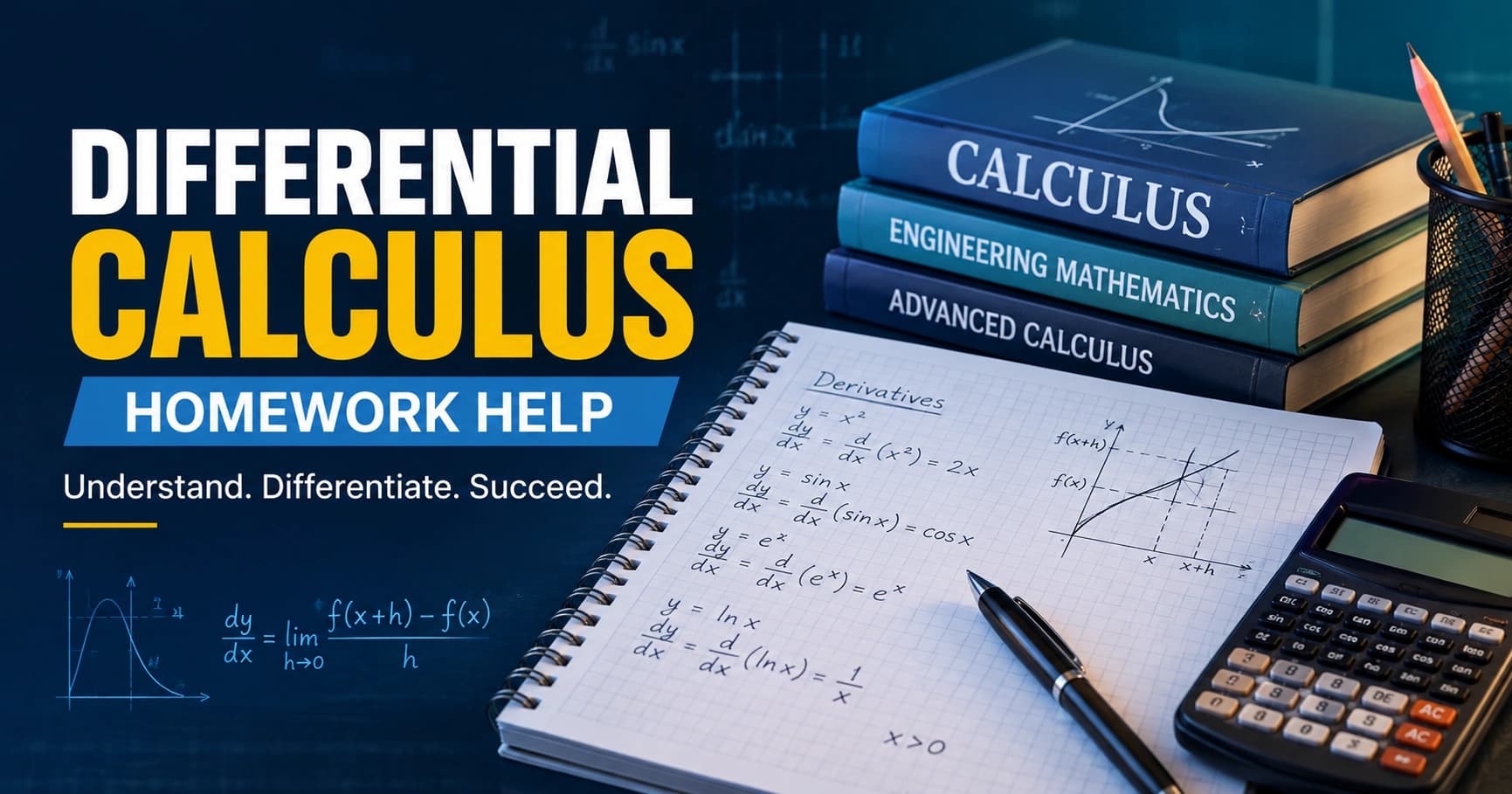
Master differential calculus with expert academic guidance. Learn limits, continuity, derivatives, optimization, related rates, curve sketching, and engineering applications through clear step-by-step explanations designed for university students.
Differential calculus is one of the most fundamental topics in university mathematics. It provides the mathematical tools needed to measure how quantities change and forms the foundation of engineering, physics, economics, computer science, finance, and many other disciplines. From analyzing the speed of a moving vehicle to optimizing manufacturing processes and training machine learning models, differential calculus plays an essential role in solving real-world problems.
Although the basic idea of finding the rate of change appears straightforward, university-level differential calculus quickly becomes more challenging. Students are expected to understand limits, continuity, derivative rules, implicit differentiation, logarithmic differentiation, optimization, related rates, and graphical analysis. Assignments often involve lengthy calculations where even a small algebraic mistake can lead to an incorrect solution.
Many students struggle because differential calculus requires more than memorizing formulas. Success depends on understanding why derivatives work, recognizing the correct technique for each problem, and applying mathematical reasoning to unfamiliar situations. As coursework progresses, assignments become increasingly application-focused, requiring students to solve engineering, business, and scientific problems using derivatives.
StudyVertex provides differential calculus homework help for university students studying mathematics, engineering, science, economics, and technology. Our academic experts guide students through complex differentiation problems using structured, step-by-step explanations that strengthen conceptual understanding while improving assignment quality.
Whether you're learning derivatives for the first time or working on advanced optimization and curve sketching problems, our goal is to help you build confidence and develop strong analytical skills.
You may also find these StudyVertex resources helpful:
- Calculus Assignment Help Online
- Integral Calculus Assignment Help
- Engineering Calculus Homework Help
- Multivariable Calculus Help
For broader academic support, explore our Math Assignment Help service.
Quick Differential Calculus Homework Checklist
Before submitting your homework, review the following checklist:
☐ Did I identify the correct differentiation rule?
☐ Have I simplified the function before differentiating?
☐ Are all derivative steps clearly shown?
☐ Did I check my algebra carefully?
☐ Have I applied the Chain Rule correctly where required?
☐ Did I verify the final answer?
☐ Have I interpreted the mathematical result correctly?
☐ Did I review every calculation before submission?
Following this checklist helps reduce common mistakes and improves the overall quality of your homework.
Article Overview
Category: Calculus Assignment Help
Updated: August 2026
Reading Time: 13–15 Minutes
Author: StudyVertex Academic Team
Table of Contents
- What Is Differential Calculus?
- Why Students Find Differential Calculus Difficult
- Topics Covered in Differential Calculus
- Common Differentiation Rules
- Common Homework Mistakes
- How Our Differential Calculus Homework Help Works
- Tips for Improving Differentiation Skills
- Frequently Asked Questions
- Final Thoughts
Key Takeaways
- Learn the fundamentals of differential calculus.
- Understand how derivatives measure rates of change.
- Master the most common differentiation rules.
- Avoid frequent mistakes in university homework.
- Improve mathematical reasoning through structured practice.
What Is Differential Calculus?
Differential calculus is the branch of calculus that studies how functions change with respect to one or more variables. Its primary objective is to calculate the derivative, which measures the instantaneous rate of change of a function.
In simple terms, derivatives tell us how quickly one quantity changes as another quantity changes.
For example, differential calculus can be used to determine:
- Speed of a moving vehicle
- Growth of a population
- Profit changes in business
- Temperature variation over time
- Electrical current in circuits
- Changing position of satellites
Because of its wide range of applications, differential calculus is considered one of the most important mathematical tools in higher education.
Understanding the Concept of Limits
Before studying derivatives, students must first understand the concept of limits.
A limit describes the value a function approaches as the input approaches a particular number.
Limits help explain:
- Continuous functions
- Instantaneous change
- Derivative definitions
- Function behavior near specific points
Without a strong understanding of limits, differentiation becomes much more difficult.
Understanding Derivatives
The derivative measures the rate at which a function changes.
Graphically, it represents the slope of the tangent line at a specific point on a curve.
Students learn how derivatives help determine:
- Increasing functions
- Decreasing functions
- Maximum values
- Minimum values
- Turning points
- Velocity
- Acceleration
Derivatives are the foundation for many advanced mathematics and engineering courses.
Why Students Find Differential Calculus Difficult
Although differentiation follows logical mathematical rules, many students struggle because assignments require both conceptual understanding and computational accuracy.
Several challenges make differential calculus one of the more demanding university mathematics subjects.
Numerous Differentiation Rules
Students are expected to learn and correctly apply several differentiation techniques, including:
- Power Rule
- Product Rule
- Quotient Rule
- Chain Rule
- Implicit Differentiation
- Logarithmic Differentiation
Selecting the correct rule is often more challenging than performing the differentiation itself.
Multi-Step Calculations
Many homework questions involve several stages.
For example, students may need to:
- Simplify an expression.
- Differentiate the function.
- Solve for critical points.
- Verify the solution.
- Interpret the mathematical meaning.
Skipping even one step can result in an incorrect answer.
Algebraic Errors
A significant number of differentiation mistakes occur because of weak algebra skills.
Common examples include:
- Incorrect simplification
- Sign errors
- Fraction mistakes
- Factoring errors
- Arithmetic slips
Carefully reviewing algebra before differentiating helps improve overall accuracy.
Applying Derivatives to Real Problems
University assignments often focus on applications rather than basic derivative calculations.
Students may need to solve problems involving:
- Optimization
- Related rates
- Motion
- Business models
- Engineering design
- Scientific experiments
These questions require mathematical reasoning in addition to computational skills.
Increasing Course Difficulty
Differential calculus begins with simple derivatives but gradually introduces more advanced concepts.
Students progress from:
- Limits
- Continuity
- Basic derivatives
to more challenging topics such as:
- Implicit differentiation
- Higher-order derivatives
- Related rates
- Optimization
- Curve sketching
- Mathematical modeling
Because each chapter builds upon previous knowledge, understanding the fundamentals is essential for long-term success.
Topics Covered in Differential Calculus
Differential calculus covers much more than finding derivatives. As students progress through university mathematics, they encounter increasingly advanced concepts that require logical reasoning, analytical thinking, and accurate mathematical calculations.
StudyVertex provides academic guidance across the complete differential calculus syllabus taught in universities worldwide.
Limits and Continuity
Every differential calculus course begins with limits because derivatives are defined using limiting processes.
Students learn:
- Left-hand limits
- Right-hand limits
- Infinite limits
- Limits at infinity
- Continuous functions
- Types of discontinuity
Understanding limits builds the conceptual foundation required for differentiation.
Basic Derivatives
Students are introduced to the derivative as the rate of change of a function.
Common topics include:
- Definition of a derivative
- First principle method
- Tangent line interpretation
- Slope of curves
- Instantaneous rate of change
Mastering basic derivatives prepares students for more advanced differentiation techniques.
Power Rule
The Power Rule is one of the first differentiation rules students learn.
It allows quick differentiation of polynomial functions.
Examples include:
- x²
- x³
- x⁵
- x⁷
Although simple, this rule appears frequently throughout university assignments.
Product Rule
When a function contains two multiplied expressions, students apply the Product Rule.
Typical examples include:
- x² sin x
- x³ eˣ
- (x² + 1)(x − 3)
Understanding when to use the Product Rule is essential for solving complex differentiation problems.
Quotient Rule
The Quotient Rule is used when differentiating fractions.
Assignments often involve functions such as:
- (x² + 1)/(x + 2)
- sin x / x
- eˣ / x²
Careful algebraic simplification is important when applying this rule.
Chain Rule
The Chain Rule is one of the most important topics in differential calculus.
Students apply it whenever one function is contained inside another.
Examples include:
- (3x² + 2)⁵
- sin(x²)
- e^(4x)
Many university homework problems combine the Chain Rule with Product Rule and Quotient Rule.
Implicit Differentiation
Not every equation is written explicitly as y = f(x).
Implicit differentiation allows students to differentiate equations containing both x and y.
Common examples include:
- x² + y² = 25
- xy = 10
- x³ + y³ = 27
These questions are common in engineering and advanced mathematics courses.
Higher-Order Derivatives
Many assignments require students to calculate:
- Second derivative
- Third derivative
- Fourth derivative
Higher-order derivatives help analyze:
- Acceleration
- Concavity
- Inflection points
- Engineering systems
Logarithmic Differentiation
Logarithmic differentiation simplifies problems involving:
- Exponential functions
- Variable exponents
- Products with multiple terms
This technique becomes especially useful in advanced university coursework.
Applications of Derivatives
Differential calculus extends beyond finding derivatives.
Students solve practical problems involving:
- Optimization
- Related rates
- Motion
- Economics
- Engineering
- Scientific modeling
Assignments increasingly emphasize real-world applications instead of routine calculations.
Common Differentiation Rules Every Student Should Know
University calculus assignments frequently require students to combine several differentiation rules within a single question.
Understanding when to apply each rule improves both speed and accuracy.
Constant Rule
The derivative of a constant is always zero.
Example:
- d/dx (7) = 0
Constant Multiple Rule
If a function is multiplied by a constant, differentiate only the variable portion.
Example:
- d/dx (5x³)
Sum Rule
Differentiate each term separately.
This rule applies to polynomial expressions containing multiple terms.
Difference Rule
Subtract the derivatives of each individual function.
This rule follows the same logic as the Sum Rule.
Product Rule
Used whenever two functions are multiplied together.
Remember:
Differentiate the first function while keeping the second unchanged, then differentiate the second while keeping the first unchanged.
Quotient Rule
Used whenever functions are divided.
Careful organization helps avoid algebra mistakes.
Chain Rule
Used whenever a function appears inside another function.
The Chain Rule is often tested in combination with trigonometric, logarithmic, and exponential functions.
Common Homework Mistakes
Many students understand the concepts but still lose marks because of avoidable errors.
Recognizing these mistakes can significantly improve homework quality.
Forgetting the Chain Rule
Students often differentiate only the outer function while forgetting to differentiate the inner expression.
This is one of the most common university mistakes.
Algebra Mistakes
Incorrect simplification often leads to wrong answers.
Examples include:
- Missing brackets
- Incorrect signs
- Fraction errors
- Arithmetic mistakes
Strong algebra skills remain essential throughout differential calculus.
Skipping Steps
Some students write only the final derivative.
University instructors usually award marks for mathematical reasoning.
Showing each step improves readability and helps identify mistakes.
Using the Wrong Rule
Choosing the incorrect differentiation rule frequently results in unnecessary calculations.
Before differentiating, identify whether the function requires:
- Product Rule
- Quotient Rule
- Chain Rule
Correct rule selection saves time.
Ignoring Units
Application questions often require units.
For example:
- metres per second
- kilometres per hour
- dollars per unit
Always include units whenever the problem involves real-world quantities.
How Our Differential Calculus Homework Help Works
StudyVertex provides structured academic support designed to improve conceptual understanding while helping students complete university coursework successfully.
Submit Your Homework
Share:
- Homework questions
- Assignment instructions
- Course syllabus
- University guidelines
- Submission deadline
Providing complete information helps us understand your academic requirements.
Get Matched With a Calculus Expert
Your homework is reviewed by a subject specialist experienced in university mathematics.
Depending on your course, we assign experts from:
- Mathematics
- Engineering
- Physics
- Economics
- Applied Sciences
This ensures accurate academic guidance.
Receive Step-by-Step Explanations
Instead of simply providing answers, our experts explain:
- Why a method is used
- How formulas are selected
- Each differentiation step
- Common mistakes to avoid
- Alternative solution methods
This approach helps students improve their independent problem-solving skills.
Review Before Submission
Before submitting your homework, carefully verify:
- Derivative calculations
- Algebra
- Graphs
- Mathematical notation
- Units
- Final answers
A thorough review helps eliminate small mistakes that can reduce marks.
Tips for Improving Differential Calculus Skills
Becoming proficient in differential calculus requires consistent practice, conceptual understanding, and attention to detail. The following strategies can help students solve homework problems more confidently and improve their overall performance.
Strengthen Your Algebra Foundation
Many differentiation errors occur because of weak algebra rather than calculus itself.
Practice:
- Simplifying expressions
- Factoring polynomials
- Solving equations
- Working with fractions
- Exponents and logarithms
Strong algebra skills make differentiation much easier.
Learn the Meaning of the Derivative
Instead of memorizing formulas, understand what a derivative represents.
Remember that a derivative measures:
- Rate of change
- Slope of a tangent line
- Instantaneous change
- Function behavior
Understanding these ideas makes advanced topics much easier to learn.
Memorize the Basic Rules
Students should become familiar with the most frequently used differentiation rules, including:
- Power Rule
- Product Rule
- Quotient Rule
- Chain Rule
Quick recall saves valuable time during assignments and examinations.
Practice Daily
Differential calculus improves through regular practice.
Even solving three or four problems every day helps improve:
- Speed
- Accuracy
- Confidence
- Mathematical reasoning
Consistent practice is more effective than last-minute revision.
Check Every Solution
Before submitting homework, verify:
- Algebra
- Negative signs
- Simplification
- Derivative rules
- Final answers
Small mistakes can significantly affect the overall solution.
Software Used in Differential Calculus
Many universities encourage students to use technology for visualization and verification.
Popular calculus software includes:
- MATLAB
- Wolfram Alpha
- Mathematica
- Maple
- GeoGebra
- Desmos
These tools help students visualize functions, verify derivatives, and understand mathematical concepts more effectively.
Real-World Applications of Differential Calculus
Differential calculus is widely used in engineering, science, business, healthcare, and technology.
Understanding these applications helps students appreciate why derivatives are so important.
Engineering
Engineers use derivatives to:
- Analyze machine performance
- Design bridges
- Study stress and strain
- Optimize manufacturing
- Model electrical systems
Differential calculus is fundamental to almost every engineering discipline.
Physics
Physics relies heavily on derivatives for studying:
- Motion
- Velocity
- Acceleration
- Force
- Energy
- Electromagnetism
Many university physics courses require strong differentiation skills.
Economics
Economists use differential calculus for:
- Marginal cost
- Marginal revenue
- Profit maximization
- Cost optimization
- Demand analysis
These concepts support better business decision-making.
Computer Science
Modern computing uses derivatives in:
- Artificial Intelligence
- Machine Learning
- Deep Learning
- Optimization algorithms
- Computer Graphics
Gradient-based optimization is one of the core applications of differential calculus in AI.
Medicine
Medical researchers apply differential calculus in:
- Disease modeling
- Medical imaging
- Drug development
- Population growth analysis
Mathematical models help improve healthcare research and planning.
Finance
Financial analysts use derivatives for:
- Investment modeling
- Risk assessment
- Portfolio optimization
- Option pricing
- Forecasting
Differential calculus supports many modern financial models.
Why Choose StudyVertex for Differential Calculus Homework Help?
StudyVertex supports university students by providing structured academic guidance designed to improve conceptual understanding and mathematical confidence.
Our support includes:
- ✔ Step-by-step derivative solutions
- ✔ University subject experts
- ✔ Clear mathematical explanations
- ✔ Accurate calculations
- ✔ Homework guidance
- ✔ Personalized academic support
- ✔ Assistance for undergraduate and postgraduate students
- ✔ Support across engineering, mathematics, science, and economics
We focus on helping students understand differential calculus while improving their problem-solving abilities.
Frequently Asked Questions
What topics are included in differential calculus homework help?
We assist with limits, continuity, derivatives, Product Rule, Quotient Rule, Chain Rule, implicit differentiation, logarithmic differentiation, optimization, related rates, and curve sketching.
Can you help with engineering differential calculus assignments?
Yes. We provide academic guidance for engineering mathematics, optimization, motion analysis, and university-level calculus coursework.
Do you explain every differentiation step?
Yes. Every solution includes detailed step-by-step explanations that help students understand the reasoning behind each calculation.
Can you help with online differential calculus homework?
Yes. We assist students with coursework, assignments, quizzes, WebAssign, MyMathLab, and other online university learning platforms while maintaining academic integrity.
Do you support advanced differential calculus topics?
Absolutely. We help students with introductory differentiation, higher-order derivatives, optimization, related rates, implicit differentiation, and engineering applications.
Related StudyVertex Guides
Continue learning with our mathematics resources:
- Calculus Assignment Help Online
- Integral Calculus Assignment Help
- Multivariable Calculus Help
- Engineering Calculus Homework Help
- Math Assignment Help
- Linear Algebra Assignment Help
- Abstract Algebra Assignment Help
Final Thoughts
Differential calculus is a cornerstone of higher mathematics and an essential subject for students pursuing engineering, science, economics, computer science, and related disciplines. By understanding how functions change and applying derivatives to solve practical problems, students develop valuable analytical and problem-solving skills that extend far beyond the classroom.
Although differentiation can seem challenging at first, success comes from mastering the fundamentals, practicing consistently, and understanding the concepts behind each technique. With a strong foundation in limits, derivatives, and their applications, students are better prepared for advanced calculus courses and real-world problem solving.
Need Differential Calculus Homework Help?
If you're struggling with differential calculus assignments, StudyVertex is here to help. Our experienced subject experts provide personalized academic guidance to help you understand concepts, solve complex differentiation problems, and improve your confidence in university mathematics.
Whether you need help with limits, derivatives, optimization, implicit differentiation, or engineering applications, we are committed to supporting your academic success through clear explanations and structured learning.
Explore our services:
At StudyVertex, we help students master differential calculus, strengthen mathematical reasoning, and achieve better academic outcomes with confidence.