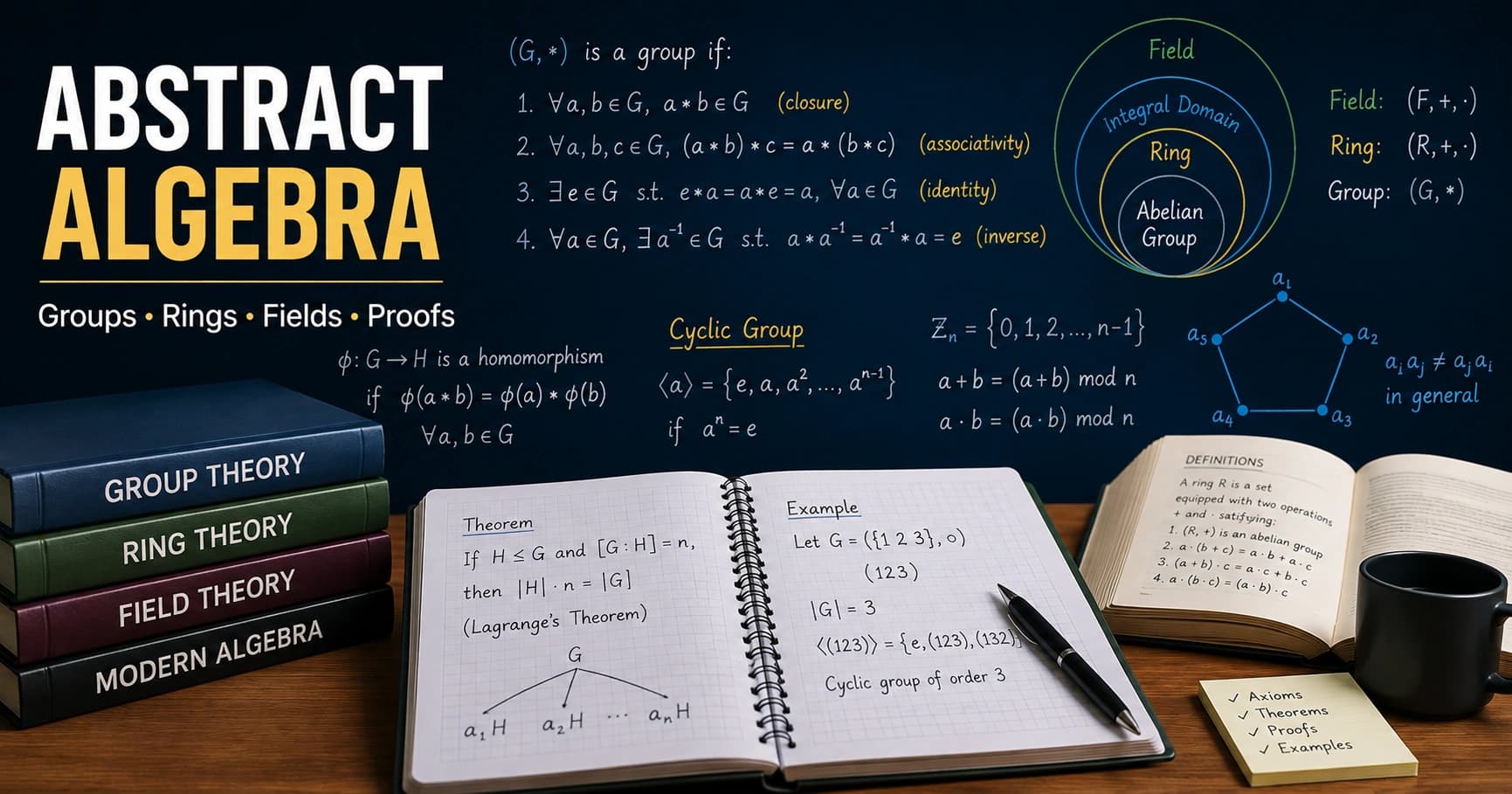
Abstract algebra, sometimes called modern algebra, is often the course where students first encounter mathematics as a study of structure rather than computation. Instead of solving for a specific number, abstract algebra asks students to reason about groups, rings, and fields general structures defined by a small set of axioms and to prove properties about them using formal logical arguments.
StudyVertex provides abstract algebra assignment help for university students working through group theory, ring theory, field theory, and the proof-writing skills that this subject demands. Our specialists focus on building genuine understanding of why the axioms and theorems hold, since abstract algebra rewards conceptual clarity far more than memorization.
For related support, see our Linear Algebra Assignment Help guide, or explore our full Math Assignment Help hub.
Why Abstract Algebra Is a Turning Point for Math Students
For many math majors, abstract algebra is the course where the subject shifts most dramatically from computation to pure reasoning.
Structures over numbers. Instead of solving for x, abstract algebra studies sets equipped with operations — groups, rings, fields — and asks what properties follow logically from a small set of defining axioms.
Proof is the primary skill. Nearly every assignment involves constructing a formal proof, whether that's showing a structure satisfies certain axioms, proving a homomorphism preserves structure, or demonstrating a quotient group is well-defined.
Abstraction can obscure intuition. Because the objects being studied are defined abstractly, it's easy to lose sight of concrete examples that would otherwise make a theorem's meaning clear part of learning the subject well is constantly grounding abstract definitions in specific examples.
It changes how later math is understood. Many students find that after abstract algebra, they understand earlier courses (even basic algebra) more deeply, because they can now see the underlying structural reasons why certain operations behave the way they do.
Abstract Algebra Topics We Cover
Group Theory
Understanding the group axioms (closure, associativity, identity, inverses), working with subgroups, cyclic groups, symmetric groups, and cosets, and proving properties like Lagrange's theorem form the foundation of most abstract algebra courses.
Homomorphisms and Isomorphisms
Determining whether a function between two groups (or rings) preserves structure, understanding kernels and images, and proving the first isomorphism theorem are central skills tested throughout the course.
Quotient Groups and Normal Subgroups
Constructing quotient groups from normal subgroups and understanding why normality is required for the quotient structure to be well-defined is a common source of conceptual difficulty.
Ring Theory
Studying structures with two operations (addition and multiplication), working with ideals, quotient rings, and understanding the distinction between commutative rings, integral domains, and fields.
Field Theory
Understanding field extensions, working with polynomial rings over a field, and for more advanced courses, an introduction to Galois theory connecting field extensions to group theory.
Proof Techniques
Direct proof, proof by contradiction, proof by induction, and constructing counterexamples are all skills abstract algebra courses expect students to apply fluently and precisely.
Why Proof-Writing Is the Hardest Part for Most Students
Many students entering abstract algebra have solved plenty of equations but have limited experience writing rigorous, formal proofs, which makes this the primary hurdle in the course.
Knowing where to start. Unlike a computational problem with a clear procedure, a proof question often requires deciding which definition or theorem to apply first — a skill that develops through exposure to many worked examples.
Precision in language. Abstract algebra proofs require exact, unambiguous statements — using "for all" and "there exists" correctly, and avoiding informal language that would be acceptable in earlier math courses but isn't rigorous enough here.
Distinguishing what needs to be proven from what can be assumed. Students sometimes use a result they haven't yet established, or fail to use a hypothesis given in the problem, both of which are common early proof-writing mistakes.
Recognizing proof patterns. Certain types of statements (showing a set is a subgroup, showing a map is a homomorphism) follow recognizable proof structures — once a student sees enough examples of a pattern, writing a new proof of the same type becomes far more approachable.
Common Mistakes in Abstract Algebra Assignments
Confusing a specific example with a general proof. Showing that a property holds for one particular element or group doesn't prove it holds in general — a very common error for students newer to abstract reasoning.
Misapplying group axioms. Assuming a structure is a group without verifying all four axioms (closure, associativity, identity, inverses) individually.
Forgetting well-definedness checks. When defining a function on a quotient structure, forgetting to check that the definition doesn't depend on the choice of representative is a frequent and easy-to-miss error.
Circular reasoning. Using the statement being proven as part of the proof itself, often unintentionally, is a subtle mistake that becomes easier to catch with practice and feedback.
Skipping concrete examples while studying. Trying to understand a new definition purely abstractly, without working through a specific example (like the symmetric group S3 or the integers under addition), often makes the material harder to retain than it needs to be.
How Abstract Algebra Connects to Other Fields
While abstract algebra is often taken purely as a mathematics requirement, its structures show up in unexpected places once you start looking for them.
Cryptography relies heavily on group theory and number theory — public-key cryptographic systems like RSA depend directly on properties of modular arithmetic and finite groups that are first formalized in an abstract algebra course.
Chemistry and crystallography use group theory to classify molecular symmetry and crystal structures, since the symmetries of a physical object form a group under composition.
Coding theory, which underlies error-correcting codes used in everything from CDs to satellite communication, is built on ring and field theory, particularly finite fields.
Physics, especially particle physics, uses group theory extensively to classify particles and describe symmetries in physical laws — the Standard Model of particle physics is deeply connected to specific abstract algebraic structures.
Seeing these applications doesn't make the proofs themselves easier, but it can make the underlying structures feel less like an arbitrary academic exercise and more like a genuinely powerful set of tools, which some students find motivating when the material feels especially abstract.
A Closer Look at Learning Group Theory
Since group theory is typically the first major topic in an abstract algebra course and sets the tone for everything that follows, it's worth examining what tends to trip students up specifically here.
The axioms feel simple but proving membership is not. The four group axioms are easy to state, but showing that a specific set with a specific operation actually satisfies all four — especially closure and the existence of inverses — requires careful, example-specific work.
Non-abelian groups challenge intuition. Students accustomed to numbers, where multiplication is commutative, often need extra practice internalizing that in groups like the symmetric group, the order of the operation matters (ab does not necessarily equal ba).
Cosets and Lagrange's theorem require visualizing partitions. Understanding that cosets partition a group into equal-sized pieces, and that this directly implies a subgroup's order must divide the group's order, is a conceptual leap that benefits enormously from working through small concrete examples like subgroups of a group of order 8 or 12.
Cyclic groups are a useful anchor. Because cyclic groups are relatively easy to understand and visualize (generated by a single element), returning to them as a reference point when a new, more abstract concept is introduced often helps ground the new material.
How Our Abstract Algebra Assignment Help Works
Share your assignment questions, relevant definitions and theorems from your course, and your deadline, and we'll match you with a specialist experienced specifically in abstract algebra's proof-based approach. You'll receive clear explanations of both the reasoning behind a proof and feedback on your own proof attempts, helping you build this skill for future assignments and exams.
Tips for Studying Abstract Algebra Effectively
Work through concrete examples for every abstract definition. Before trying to prove a general statement, verify it manually for a small, specific example like the integers mod n or a small symmetric group — this builds the intuition that makes the general proof approachable.
Rewrite proofs in your own words after seeing them. Copying a proof from a textbook or lecture doesn't build the same understanding as reconstructing it independently a day later.
Study definitions as carefully as theorems. In abstract algebra, a huge portion of difficulty comes from not having definitions precisely memorized — many "proof" difficulties are actually just not remembering exactly what needs to be shown.
Form or join a study group focused on proof review. Abstract algebra proofs benefit enormously from having someone else check your logic, since it's easy to miss a gap in your own reasoning that's obvious to a second reader.
Why Choose StudyVertex for Abstract Algebra Help
Our specialists have genuine academic depth in pure mathematics, not just general math tutoring experience, and understand the specific proof-writing conventions abstract algebra courses expect. We focus on building your ability to construct rigorous arguments independently, which is the skill that ultimately determines success in this course far more than any single assignment.
Frequently Asked Questions
What topics does abstract algebra assignment help cover?
We cover group theory, ring theory, field theory, homomorphisms and isomorphisms, quotient structures, and the proof-based reasoning central to abstract algebra courses.
Is abstract algebra the same as linear algebra?
No. Abstract algebra studies general algebraic structures like groups, rings, and fields, while linear algebra focuses specifically on vector spaces and linear transformations — though both use similar proof-based reasoning.
Can you help me write formal proofs for abstract algebra assignments?
Yes, helping students construct clear, rigorous proofs is a core part of our abstract algebra assignment help, since most coursework in this subject is proof-based rather than computational.
Is abstract algebra help available for graduate-level courses?
Yes, we support both undergraduate introductory abstract algebra and graduate-level modern algebra coursework.
Why is abstract algebra considered more difficult than earlier math courses?
Abstract algebra requires reasoning about general structures and their properties rather than working with specific numbers, which demands a different, more abstract style of mathematical thinking that many students encounter for the first time in this course.
Related Math Guides
- Math Assignment Help
- Linear Algebra Assignment Help
- College Algebra Assignment Help
- Matrix Algebra Homework Help
Need Help With an Abstract Algebra Assignment?
Share your assignment details and get matched with a specialist experienced in group theory, ring theory, and formal proof-writing. Explore our Math Assignment Help service to get started.