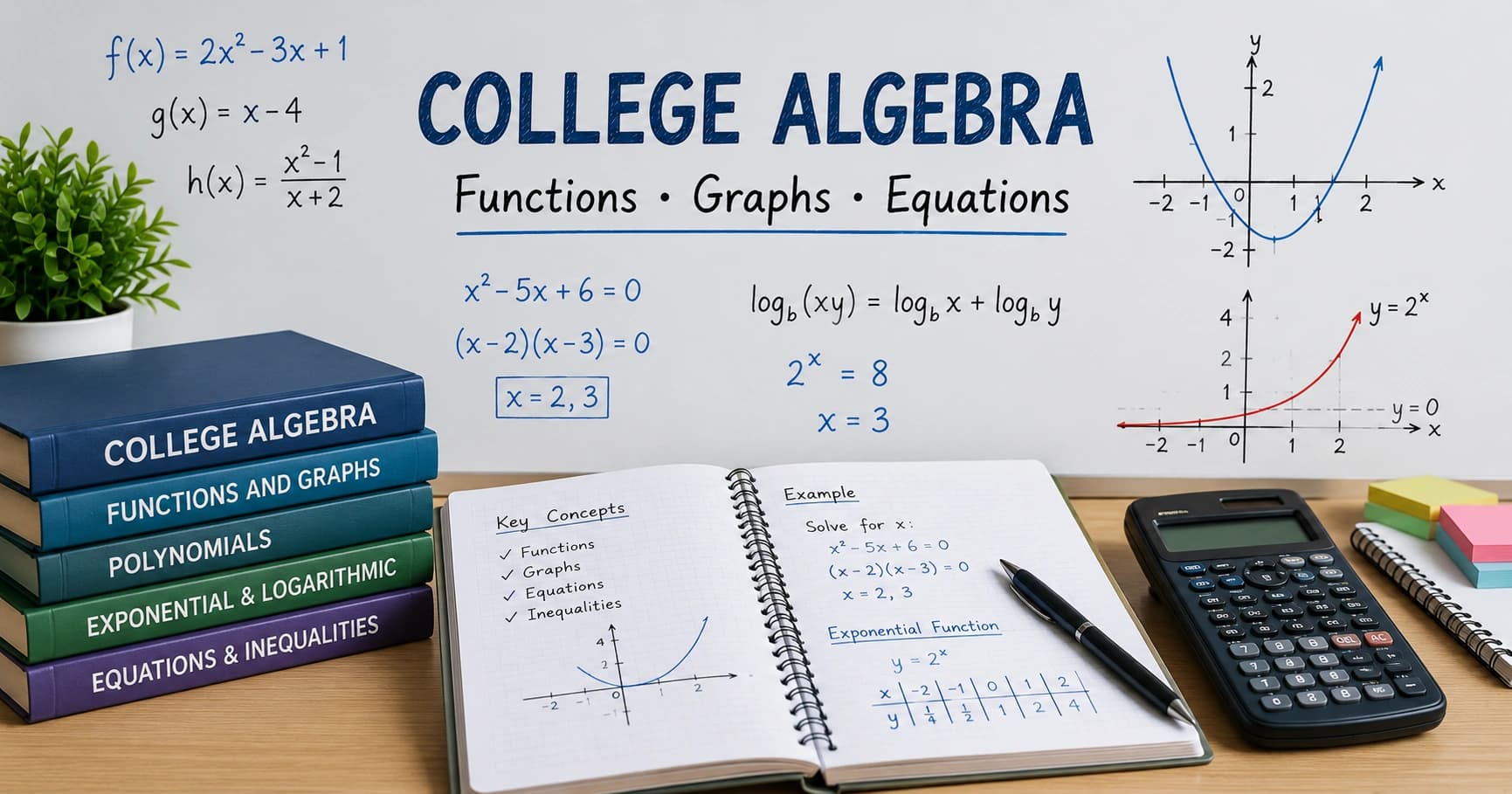
College algebra typically serves as a bridge course — building on high school algebra while introducing the function-based thinking that pre-calculus and calculus courses depend on. For many students, particularly those returning to math after a gap or taking it as a general education requirement, college algebra assignments move faster and go deeper than what they remember from high school, which can make the course feel unexpectedly difficult.
StudyVertex provides college algebra assignment help for students working through functions, graphing, polynomial and rational functions, exponential and logarithmic equations, and the broader function-based reasoning that college-level algebra emphasizes. Our specialists help connect each new topic to the algebra fundamentals you already know, so the course builds logically rather than feeling like an entirely new subject.
For foundational algebra support, see our Algebra Homework Help guide, or explore our full Math Assignment Help hub.
What Makes College Algebra Different
College algebra courses are usually designed to move at a faster pace than high school algebra and place heavier emphasis on functions as the central organizing concept, rather than treating equations and graphing as separate topics.
Function-centered approach. Nearly every topic in college algebra — polynomials, rational expressions, exponentials, logarithms — is taught through the lens of functions: their domain, range, behavior, and graph, rather than as isolated equation-solving techniques.
Faster pacing. A full semester of college algebra often covers material that spans two years of high school algebra, which means less time is available to revisit foundational gaps before moving to new material.
Direct preparation for calculus. Many college algebra courses are explicitly designed as a pre-calculus on-ramp, meaning topics are chosen specifically because they'll be needed again almost immediately in a calculus course.
More emphasis on graph interpretation. College algebra assignments frequently ask students to interpret a graph's behavior — asymptotes, end behavior, intervals of increase or decrease — rather than just solving for a numeric answer.
College Algebra Topics We Cover
Functions and Their Graphs
Understanding function notation, domain and range, evaluating functions, and identifying key features of a graph (intercepts, symmetry, increasing/decreasing intervals) forms the foundation for nearly everything else in the course.
Transformations of Functions
Shifting, stretching, compressing, and reflecting graphs based on changes to a function's equation is a skill tested repeatedly across different function types throughout the course.
Polynomial Functions
Analyzing the behavior of polynomial functions, finding zeros, understanding end behavior, and working with the factor theorem and synthetic division to break down higher-degree polynomials.
Rational Functions
Identifying vertical and horizontal asymptotes, holes in a graph, and domain restrictions for functions involving a variable in the denominator, along with solving rational equations.
Exponential and Logarithmic Functions
Understanding exponential growth and decay, converting between exponential and logarithmic form, applying logarithm properties, and solving exponential and logarithmic equations — often one of the more challenging sections of the course.
Systems of Equations and Inequalities
Extending earlier algebra skills to systems involving nonlinear equations, and working with systems of inequalities and their graphical solution regions.
Sequences and Series
An introduction to arithmetic and geometric sequences and series, including summation notation, which often appears toward the end of a college algebra course as a bridge into later math topics.
Common Mistakes in College Algebra Assignments
Confusing function transformations. Mixing up whether a change inside versus outside a function's parentheses shifts the graph horizontally or vertically is one of the most common sources of error.
Errors with logarithm properties. Misapplying rules for combining or expanding logarithmic expressions — particularly the rules for logarithms of products, quotients, and powers — frequently leads to incorrect equation solutions.
Missing domain restrictions. Forgetting that logarithmic functions are only defined for positive inputs, or that rational functions exclude values that make the denominator zero, leads to including invalid solutions.
Sign errors in synthetic division. A single arithmetic slip during synthetic division can produce an entirely incorrect quotient, which then affects every subsequent step of a polynomial problem.
Rushing graph interpretation questions. Because college algebra places heavy emphasis on reading and interpreting graphs, skimming past small details — like distinguishing an open versus closed interval — is a common source of lost points.
How Our College Algebra Assignment Help Works
Share your specific assignment questions, course materials, and deadline, and we'll match you with a specialist experienced in the function-based approach that college algebra courses take. You'll receive clear, step-by-step explanations designed to connect back to material you'll need again in pre-calculus or calculus, along with the chance to ask follow-up questions about any step that isn't fully clear.
Many students also use these sessions to work through a handful of extra practice problems beyond the assigned homework, particularly before a quiz or exam covering the same material — reinforcing a concept through a second or third worked example is often what turns a shaky understanding into a confident one.
Preparing for College Algebra as a Returning Student
Many college algebra students are returning to math after a gap of several years, whether from another field of study, work experience, or a break between high school and college. A few strategies help specifically in this situation:
Don't assume you need to relearn everything from scratch. Most returning students find that foundational skills come back faster than expected once a specific concept is reviewed — the goal is targeted review, not starting over completely.
Focus extra attention on function notation. If your high school algebra didn't emphasize function notation heavily, spending extra time getting comfortable with it early will make the rest of the course significantly smoother, since nearly every topic builds on it.
Use office hours and outside help early, not as a last resort. Because college algebra moves quickly, addressing a gap in week 2 is far easier than trying to catch up in week 10 after several topics have built on top of it.
Why College Algebra Matters Even for Non-STEM Majors
College algebra is frequently a required general education course regardless of major, which leads some students to wonder why it matters outside of STEM fields. In practice, the reasoning and function-based thinking it develops has broader applications than students often expect.
Business and economics rely on functions constantly — modeling cost, revenue, and profit as functions of quantity produced, or understanding exponential growth in the context of interest rates and investment returns, are both direct applications of college algebra concepts.
Social sciences and public health use exponential and logarithmic functions to model phenomena like population growth or the spread of disease, and interpreting these models requires the same graph-reading skills developed in college algebra.
Data literacy more broadly — reading a graph critically, understanding rates of change, recognizing when a relationship is linear versus exponential — is a general reasoning skill that shows up across nearly every field, from journalism to policy analysis.
Understanding this broader relevance can make the course feel less like an arbitrary requirement and more like a genuinely useful set of analytical tools, which for many students makes the material easier to engage with.
Real-World Applications in College Algebra
Connecting abstract function concepts to concrete situations often makes college algebra material click faster.
Exponential functions model compound interest, population growth, and radioactive decay — understanding the formula for compound interest, for instance, is a direct application of exponential function concepts covered in the course.
Logarithmic functions appear in contexts like the Richter scale for earthquake magnitude and pH calculations in chemistry, both of which use logarithmic scales specifically because they compress a very wide range of values into a manageable scale.
Rational functions model situations involving rates, such as concentration of a solution as more of a diluting substance is added over time, where the function has a horizontal asymptote representing the eventual limiting concentration.
Polynomial functions are used in fields like economics to model cost and revenue curves, where the zeros of the function often have direct real-world meaning, such as a break-even point.
Tools Commonly Used in College Algebra Coursework
Graphing calculators (TI-84) remain standard for verifying graphs, finding zeros, and checking function behavior in most college algebra courses.
Desmos is increasingly used for visualizing function transformations and exploring how changing parameters affects a graph's shape, which can build stronger intuition than a static textbook graph.
Online homework platforms (such as MyMathLab, WebAssign, or similar systems) are common in college algebra courses, and often require answers in a specific format — our specialists can help you understand both the math and how to correctly enter it into these systems.
Signs You'd Benefit From College Algebra Assignment Help
College algebra's faster pace means small gaps compound quickly. A few signs outside support would help:
You did well in high school algebra but find college algebra assignments taking noticeably longer than expected, which is often a pacing issue rather than an ability issue — the course simply moves faster than what you're used to. You understand individual function types (polynomials, exponentials, logarithms) in isolation but struggle when an assignment asks you to compare or combine them. You're preparing for a placement test or the transition into pre-calculus and want to shore up specific weak areas before the stakes get higher. Or you're a returning student and unsure exactly which foundational skills need review versus which ones came back naturally.
Getting a specific gap identified and addressed early in a fast-paced course tends to prevent much larger difficulties later in the semester.
Why Choose StudyVertex for College Algebra Help
Our specialists understand both the specific function-based approach college algebra courses take and how the material connects forward to pre-calculus and calculus. We focus on helping you build genuine fluency with functions and graphing — not just getting through the current assignment — so the transition into higher-level math courses feels far less abrupt.
Frequently Asked Questions
What topics are covered in college algebra assignment help?
We cover functions and graphing, polynomial and rational functions, exponential and logarithmic functions, systems of equations and inequalities, and an introduction to sequences and series.
Is college algebra different from high school algebra?
College algebra generally moves faster and covers more advanced function concepts, often serving as direct preparation for pre-calculus or calculus, whereas high school algebra 1 and 2 build the foundational skills.
Can StudyVertex help me prepare for a college algebra placement test?
Yes, many students use our college algebra assignment help sessions to review concepts and practice problems ahead of placement exams or course entry assessments.
Does college algebra help prepare me for calculus?
Yes. College algebra is typically the direct prerequisite for pre-calculus and calculus, and a strong grasp of functions, graphing, and exponential/logarithmic concepts makes those later courses significantly easier.
Can you help with online college algebra homework platforms?
Yes, we help students work through problems assigned via common online homework systems, including understanding how to correctly format and enter answers for auto-graded platforms.
Related Math Guides
- Math Assignment Help
- Algebra Homework Help Online
- Linear Algebra Assignment Help
- Calculus Assignment Help Online
Need Help With a College Algebra Assignment?
Share your assignment details and get matched with a specialist who understands the function-based approach college algebra courses take. Explore our Math Assignment Help service to get started.