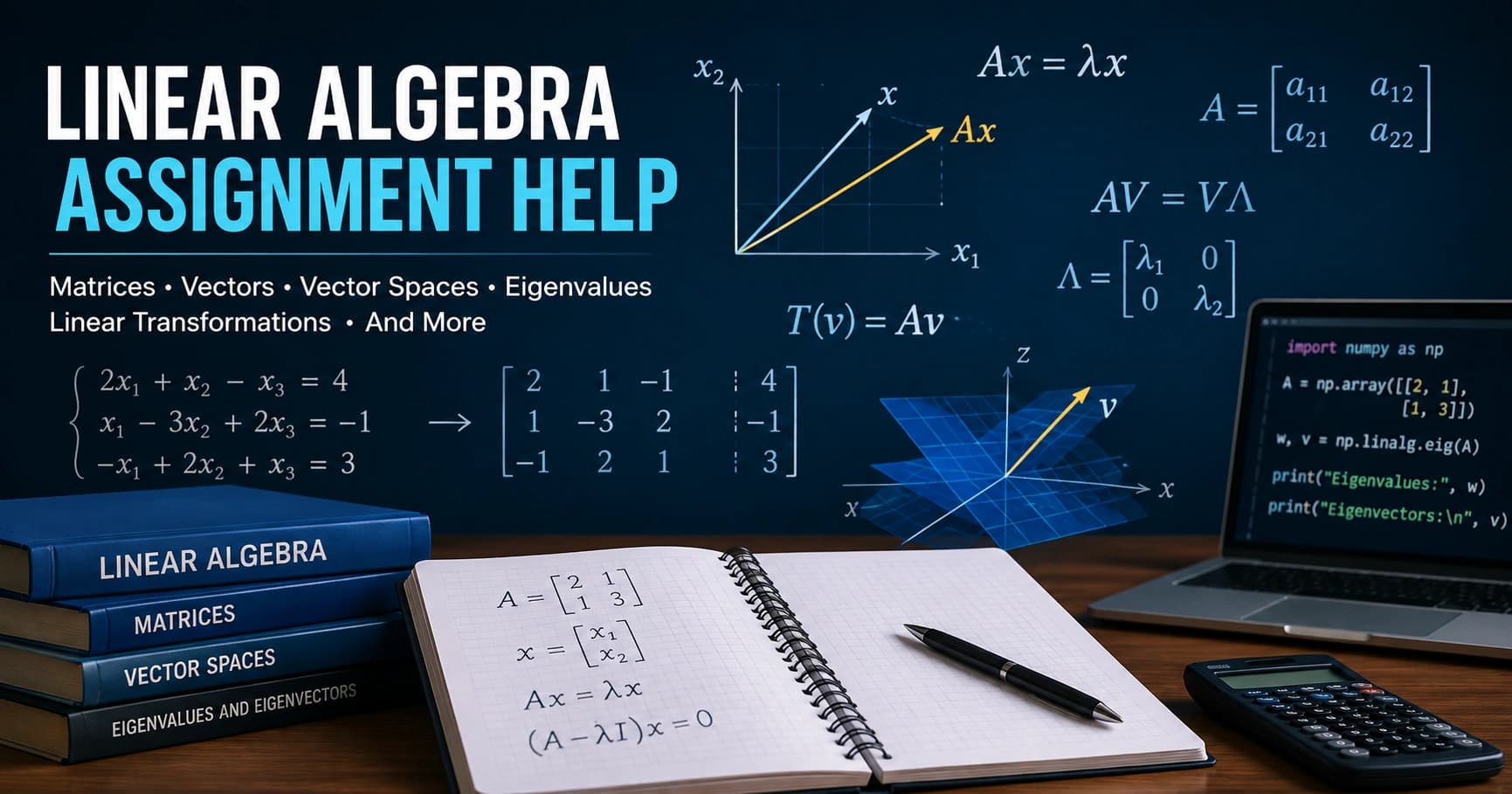
Linear algebra is one of the more conceptually demanding branches of mathematics students encounter, largely because it shifts from the concrete, single-variable thinking of earlier algebra courses into abstract structures like vector spaces, linear transformations, and matrix operations. For computer science, engineering, physics, and data science majors in particular, linear algebra assignments often feel like a different subject entirely from the algebra covered in high school.
StudyVertex provides linear algebra assignment help for university students working through matrices, vector spaces, eigenvalues, linear transformations, and the proof-based reasoning that underpins much of the subject. Our specialists focus on building genuine geometric and structural intuition, not just mechanical computation.
For a broader overview of our math support, visit our Math Assignment Help hub, or explore our Algebra Homework Help for foundational algebra support.
Why Linear Algebra Is Different From Algebra 1 and 2
Students often expect linear algebra to feel like a continuation of high school algebra, but the shift in thinking required can be significant.
Abstraction over computation. While earlier algebra courses focus on solving for a specific numeric variable, linear algebra deals with entire vector spaces and transformations objects that behave according to axioms rather than single numbers.
Geometric interpretation matters. Many linear algebra concepts, like eigenvectors or linear independence, have a genuine geometric meaning that's easy to miss if you only memorize the computational procedure.
Proof-based reasoning. Unlike earlier algebra courses that are largely computational, linear algebra frequently asks students to prove that a set of vectors forms a basis, or that a transformation is linear a different skill from solving an equation.
Heavy reliance on notation. Matrix and vector notation can look intimidating at first, and a large part of getting comfortable with the subject is simply becoming fluent in reading and manipulating that notation confidently.
Applications in computer science and engineering. Linear algebra underpins machine learning, computer graphics, signal processing, and structural engineering, which means assignments sometimes blend pure mathematical theory with applied, discipline-specific problems.
Linear Algebra Topics We Cover
Matrices and Matrix Operations
Addition, multiplication, transposition, and understanding the properties that matrix operations do and don't share with regular number arithmetic (matrix multiplication isn't commutative, for example) form the computational backbone of the course.
Systems of Linear Equations
Solving systems using Gaussian elimination, row reduction, and understanding when a system has no solution, one solution, or infinitely many solutions connects directly back to matrix representation and rank.
Vector Spaces and Subspaces
Understanding the formal axioms that define a vector space, identifying subspaces, and working with concepts like span, basis, and dimension is often where students first encounter genuinely abstract mathematical reasoning.
Linear Independence and Basis
Determining whether a set of vectors is linearly independent, and finding a basis for a given vector space, requires connecting computational row-reduction techniques to their conceptual meaning.
Eigenvalues and Eigenvectors
Computing eigenvalues and eigenvectors, understanding their geometric interpretation as directions that a transformation stretches without rotating, and applying them to diagonalization problems is one of the most heavily tested topics in the course.
Linear Transformations
Understanding how matrices represent transformations of space rotations, reflections, scaling and working with transformation composition and matrix representations of a given transformation.
Determinants
Computing determinants using cofactor expansion or row reduction, and understanding what a determinant tells you about a matrix (invertibility, volume scaling, orientation).
Orthogonality and Inner Product Spaces
Working with dot products, orthogonal and orthonormal bases, the Gram-Schmidt process, and projections onto subspaces, which frequently appear in applied linear algebra and machine learning contexts.
How Linear Algebra Connects to Computer Science and Data Science
For students in computer science, data science, or related fields, linear algebra isn't just a graduation requirement — it's the mathematical foundation for a surprising number of practical technologies.
Machine learning relies heavily on linear algebra from representing data as vectors and matrices, to the matrix operations underlying neural network computations, to techniques like principal component analysis that use eigenvalues and eigenvectors directly.
Computer graphics uses linear transformations constantly rotating, scaling, and translating objects in 2D or 3D space is fundamentally a matrix operation.
Search and recommendation algorithms frequently use matrix factorization techniques rooted directly in linear algebra concepts like eigendecomposition.
Understanding these connections often makes the abstract theory in a linear algebra course feel more motivated, which is part of why our specialists frequently tie assignment help back to these practical applications where relevant.
Common Mistakes in Linear Algebra Assignments
Treating matrix multiplication like regular multiplication. Forgetting that matrix multiplication isn't commutative (AB usually doesn't equal BA) is one of the most frequent sources of error.
Confusing a vector space's axioms with computational shortcuts. Proof-based questions asking you to verify vector space axioms require systematically checking each axiom, not just asserting that a set "looks like" a vector space.
Sign errors in cofactor expansion. Computing determinants by hand is error-prone, particularly with the alternating signs required in cofactor expansion for larger matrices.
Misunderstanding what an eigenvector represents. Students sometimes compute eigenvectors correctly but struggle to explain their geometric meaning when asked to interpret the result.
Skipping the geometric intuition. Focusing purely on the mechanical row-reduction process without understanding what it represents geometrically often leads to correct homework answers but real difficulty on exams that test conceptual understanding.
How Our Linear Algebra Assignment Help Works
Share your assignment questions, relevant course notes, and deadline, and we'll match you with a specialist whose academic background is specifically in linear algebra and its applications. You'll receive clear explanations that connect the computational steps to their underlying meaning, along with the opportunity to ask follow-up questions about anything that isn't fully clear.
Tips for Succeeding in Linear Algebra
Build geometric intuition early. Before memorizing a procedure, try to understand what it represents visually — what does it mean for two vectors to be linearly independent, geometrically? This intuition makes remembering procedures far easier.
Practice writing formal proofs. Even if your course is computation-heavy, practicing how to write a clean, step-by-step proof for concepts like linear independence will pay off on exams that test theoretical understanding.
Use software to check hand computations. Tools like MATLAB or Python's NumPy library can verify matrix computations, which is useful both for checking homework and for building confidence in your manual calculations.
Connect topics to applications you care about. If you're a computer science student, exploring how eigenvectors relate to a machine learning technique you've heard of can make the abstract math feel more concrete and worth understanding deeply.
Linear Algebra in Engineering and Physics
Beyond computer science, linear algebra is foundational for engineering and physics coursework in ways that aren't always obvious when first learning the subject.
Structural engineering uses systems of linear equations to model forces and stresses across a structure — matrix methods make it possible to solve for many unknown forces simultaneously in a way that would be impractical by hand with individual equations.
Electrical engineering relies on linear algebra for circuit analysis, particularly when dealing with multiple loops and nodes, where systems of equations describe the relationships between currents and voltages throughout a circuit.
Quantum mechanics in physics is built almost entirely on linear algebra — quantum states are represented as vectors, and physical observables correspond to linear operators, making eigenvalues and eigenvectors directly meaningful as measurable quantities.
Control systems engineering uses matrix representations of systems to analyze stability and design controllers, relying heavily on eigenvalue analysis to determine how a system behaves over time.
Recognizing these applications can help make an otherwise abstract assignment feel more concrete, and our specialists are comfortable connecting the pure mathematics back to whichever applied field a given assignment is drawn from.
Preparing for Linear Algebra Exams
Linear algebra exams often test a mix of computation and conceptual understanding, and preparing effectively requires practicing both.
Work through proofs, not just computations. If your course includes proof-based questions, practice writing complete, rigorous arguments — verifying every part of a definition rather than skipping steps that feel "obvious."
Practice recognizing which method to use. Many linear algebra problems can be solved multiple ways (row reduction, determinants, eigenvalue methods), and part of exam success is recognizing the most efficient approach for a given question rather than defaulting to the first method you learned.
Review geometric interpretations before the exam. Questions that ask you to interpret a result what does it mean for a determinant to be zero, or for a set of vectors to span a space are common, and reviewing the "why" behind procedures pays off more than pure computational drilling in the final days before a test.
Work through past exams or sample problems under timed conditions. Linear algebra computations, especially by hand, can be time-consuming — practicing under realistic time constraints helps identify which procedures need to become faster and more automatic.
Signs You'd Benefit From Linear Algebra Assignment Help
Linear algebra's abstraction means it's common to follow a lecture perfectly and still struggle when facing a blank assignment. A few signs it's worth getting outside support:
You can perform the row-reduction procedure correctly but can't explain what the result actually means about the system of equations. You understand each definition individually vector space, basis, linear independence but struggle to connect them when a problem requires using several at once. You get correct answers on computational homework but find proof-based questions much harder, suggesting the conceptual layer beneath the computation hasn't fully solidified yet. Or an assignment combines linear algebra with an applied context (physics, computer science, engineering) and the unfamiliar application is adding a layer of difficulty on top of the math itself.
Any of these are completely normal points in learning a subject this abstract, and working through a specific problem with a specialist who can identify exactly where the gap is often resolves it far faster than continuing to work through the textbook alone.
Why Choose StudyVertex for Linear Algebra Help
Our specialists have genuine academic depth in linear algebra and its applications, not just general math tutoring backgrounds. We focus equally on computational accuracy and conceptual understanding, since linear algebra courses typically test both — and we're comfortable supporting both pure theoretical coursework and applied assignments connected to computer science, engineering, or data science.
Frequently Asked Questions
What linear algebra topics does StudyVertex help with?
We cover matrices and matrix operations, systems of linear equations, vector spaces, eigenvalues and eigenvectors, linear transformations, determinants, and orthogonality.
Is linear algebra assignment help available for computer science and data science students?
Yes, our specialists understand how linear algebra applies to machine learning, computer graphics, and data science, in addition to traditional pure-math coursework.
Can you help me understand proofs in linear algebra, not just computations?
Yes. Many linear algebra courses require proof based understanding of concepts like vector space axioms and linear independence, and our specialists help build that conceptual understanding alongside computational skills.
Do you help with linear algebra software like MATLAB or Python?
Yes, we can help you interpret and work with matrix computations in MATLAB, Python (NumPy), and similar tools commonly required in linear algebra coursework.
How is linear algebra assignment help different from general algebra help?
Linear algebra deals with vectors, matrices, and abstract vector spaces rather than single-variable equations, and requires a different kind of geometric and structural thinking our linear algebra specialists have specific academic backgrounds in this area.
Related Math Guides
- Math Assignment Help
- Algebra Homework Help Online
- Abstract Algebra Assignment Help
- Matrix Algebra Homework Help
Need Help With a Linear Algebra Assignment?
Share your assignment details and get matched with a specialist experienced in matrices, vector spaces, and linear transformations. Explore our Math Assignment Help service to get started.