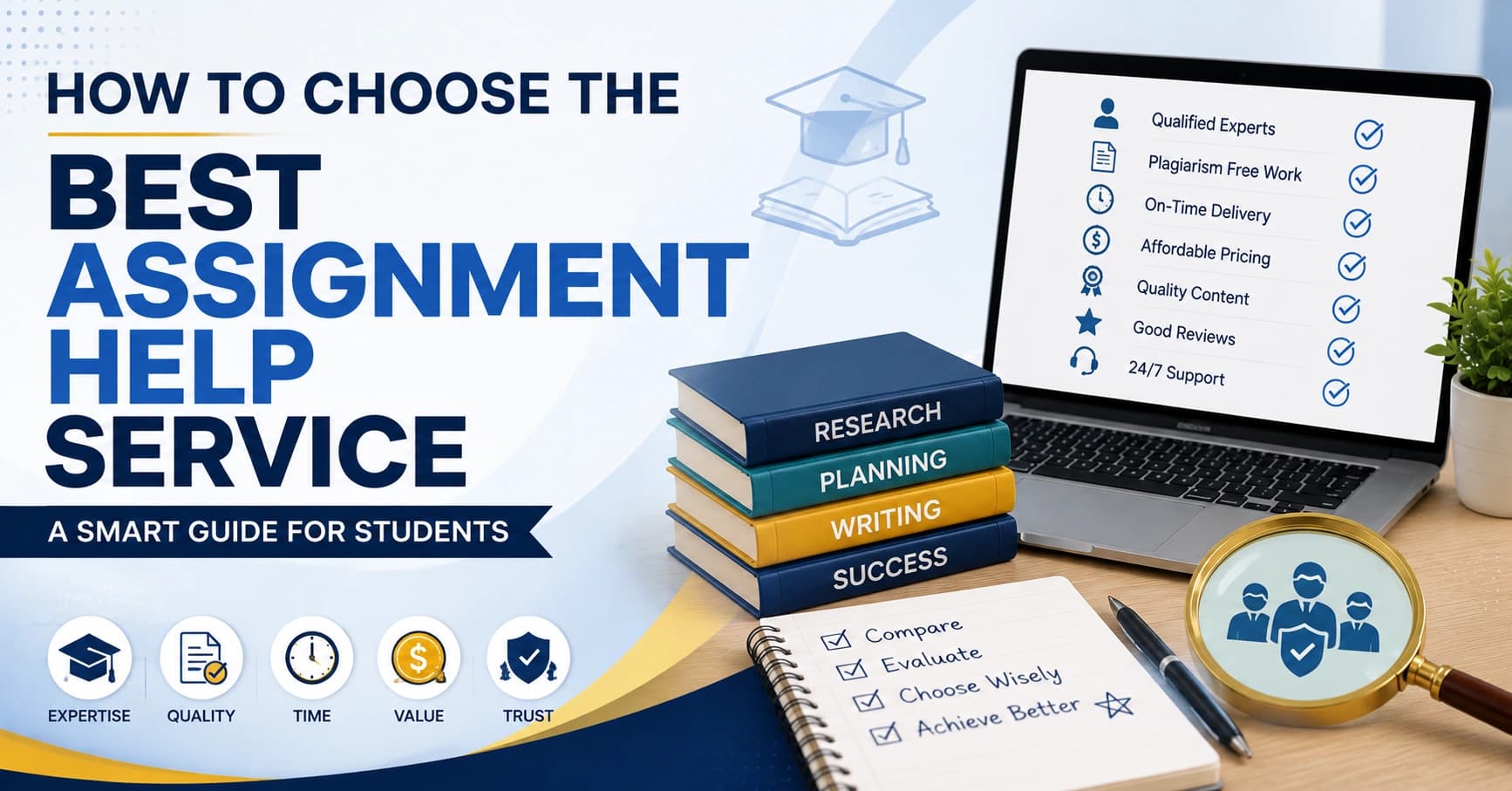
Searching "assignment help" returns dozens of options, and most of them look nearly identical at a glance similar promises, similar layouts, similar claims of "expert writers" and "on-time delivery." The actual differences that matter are usually not visible on the homepage, which is exactly why so many students end up picking a service based on price alone and finding out too late that the specialist assigned to their case didn't actually understand the subject.
This guide walks through the specific things worth checking before you commit to any assignment help service, based on the factors that actually predict whether the support you receive will be useful.
For a look at what a well-structured assignment help service actually offers, see our own Assignment Help page.
Check Who Is Actually Doing the Work
This is the single most consequential thing to verify, and it's often the least visible on a service's homepage.
Ask directly whether specialists are human or AI-generated. Some services quietly rely on AI tools to generate content and present it as expert work. This matters because AI-generated academic content tends to be generic, sometimes factually unreliable, and increasingly detectable by university plagiarism and AI-detection tools putting your academic standing at risk in a way that isn't obvious until it's too late.
Check whether specialists are matched by subject. A service that assigns "writers" generically, without regard to whether they actually studied your subject, produces noticeably shallower work than one that matches a physics assignment to someone with a physics background and a nursing case study to someone with clinical training.
Look for any information about specialist qualifications. This doesn't need to be a full resume, but a legitimate service should be able to describe, even briefly, the kind of academic background their specialists have.
Understand Exactly What's Included
Vague service descriptions ("we help with all your academic needs") are a weak signal. Specific descriptions are a strong one.
Subject Coverage
Check whether the service explicitly lists the subjects it supports, and whether your specific subject is genuinely covered not just implied by a generic "all subjects" claim. A service with a dedicated page for your subject area (engineering, nursing, computer science, and so on) has usually invested more in actually supporting it well.
Type of Support Offered
Some services only offer full assignment completion. Others also support editing, proofreading, concept explanation, or working through a problem alongside you. Knowing which type of support you actually need and confirming the service offers it avoids a mismatch later.
Revision Policy
Check whether revisions are included if the delivered work doesn't fully meet your assignment's requirements, and whether there's a time limit on requesting them.
Evaluate Transparency Around Pricing
Assignment help pricing legitimately varies by complexity and deadline, so a single fixed price list isn't always a red flag by itself but a complete absence of pricing information, or pressure to pay before you understand what you're getting, is worth noticing.
Reasonable transparency looks like: a clear explanation of what affects price (subject, deadline, complexity), and a specific quote before you commit to payment.
Weaker transparency looks like: vague "contact us for pricing" with no explanation of what determines the cost, or upsells that appear only after you've already started the process.
Check for a Real Plagiarism and Originality Policy
Academic integrity tools at universities have become significantly more sophisticated, and a service that doesn't take originality seriously puts your academic record at risk, not just theirs.
Look for an explicit statement that work is checked for originality before delivery, not just a generic claim of "100% original work" without explanation of how that's verified.
Look at Response Time and Communication
How a service handles your very first inquiry is a reasonable predictor of how they'll handle you as an ongoing student.
Good signs: a specific, relevant response to your actual question, rather than a copy-pasted generic reply. Reasonable response time, especially if you've indicated an urgent deadline.
Weak signs: automated responses that don't address what you actually asked, or long delays even for simple questions before you've paid anything.
Consider Whether the Service Supports Your Specific Situation
International Student Needs
If you're studying outside your home country, check whether the service has experience with your specific university system's expectations citation styles, formatting conventions, and academic norms vary meaningfully between the US, UK, Australia, and Canada.
Urgent Deadlines
If you sometimes need help on short notice, confirm the service genuinely supports urgent requests rather than only advertising fast turnaround without being able to deliver on it consistently.
Ongoing Support vs. One-Off Help
Some students need help with a single assignment; others want a service they can return to throughout a semester. If you expect to need help more than once, it's worth choosing a service you can build a working relationship with, rather than starting from scratch with a new provider every time.
A Practical Checklist
Before committing to a service, you should be able to answer yes to most of these:
- Do they clearly state that human specialists (not AI) handle the work?
- Do they match specialists by subject rather than assigning generically?
- Is pricing explained, even if it requires a specific quote?
- Is there a stated plagiarism/originality policy?
- Did they respond to your specific question, not a generic template?
- Do they explicitly support your subject and academic level?
- Is there a clear revision policy?
Common Red Flags Worth Recognizing
Beyond the checklist above, a few specific warning signs tend to correlate strongly with a poor experience.
No way to communicate with the specialist working on your assignment. If a service only allows contact through a generic support inbox with no path to ask the specialist a clarifying question about your specific requirements, it's harder to catch a misunderstanding before it affects the final result.
Guarantees that sound too absolute. Claims like "guaranteed A+ grade" go beyond what any legitimate academic support service can honestly promise grading depends on your instructor's specific rubric, which no outside service controls.
Pressure to decide immediately. Countdown timers, "only 2 spots left today," or similar urgency tactics are marketing patterns borrowed from e-commerce, not typical of academic support services focused on quality.
No information about the company itself. A legitimate service usually has some visible information — an About page, a way to understand who's behind it rather than being a bare landing page with a payment form.
Reviews that all sound identical. Genuine student feedback tends to be varied and specific (mentioning particular subjects, specific things that helped). A wall of generic five-star reviews with similar phrasing is worth treating with some skepticism.
Questions Worth Asking Before You Pay
If a service passes your initial checks, a short round of direct questions before committing can save you from a bad experience later.
"Can you tell me about the specialist who'll work on this?" Even a brief, specific answer (subject background, general experience level) is a good sign. A vague non-answer is not.
"What happens if I need a revision?" You want a clear answer here, not a redirect to buried terms and conditions.
"How will you handle it if my deadline moves up?" Life happens knowing whether a service can flex on timing before you're in a genuine crunch is more useful than finding out under pressure.
"Is my personal and academic information kept confidential?" A direct, confident answer here matters more than you might expect — you're sharing coursework details and sometimes personal circumstances, and a service that treats this casually is a signal worth noticing.
Comparing a Few Services Side by Side
If you're deciding between two or three options, it often helps to evaluate them against the same short list of criteria rather than judging each in isolation:
- Do they clearly state who does the work (human specialists vs. AI)?
- Is your specific subject explicitly supported, not just implied?
- Is pricing explained before you're asked to commit?
- Did their response to your first question feel specific and genuine?
- Is there a real, explained revision and originality policy?
Scoring each option against the same five points, even informally, tends to surface a clearer choice than comparing marketing pages against each other directly — marketing pages are, after all, designed to all look equally appealing.
What Happens After You Choose
Once you've picked a service, a few habits help ensure the experience actually goes well:
Provide complete instructions upfront. The single biggest cause of unsatisfactory delivered work is incomplete or unclear instructions at the start not a service's lack of effort. Include your assignment brief, any rubric provided, formatting requirements, and relevant course materials.
Ask questions early, not just at the end. If a service allows communication with your specialist, a quick clarifying question partway through is far more useful than only reviewing the finished result.
Review what's delivered against your original requirements. Before accepting delivered work as final, check it against your assignment brief point by point rather than skimming it — this is when a genuine mismatch is easiest to catch and correct.
Why Subject-Specific Matching Actually Matters
It's worth spending a bit more time on this point specifically, since it's the factor students most often underweight when comparing services.
A generalist writer, however skilled at writing in general, approaches an engineering problem set differently than someone who has actually studied engineering. They can produce something that reads fluently and looks complete, but subtle technical errors a misapplied formula, an engineering concept used slightly incorrectly are much more likely, and much harder for a non-specialist student to catch themselves, since the whole point of seeking help is often that the subject isn't yet fully familiar.
The difference becomes especially visible in follow-up situations: if your instructor asks a question about the submitted work, or if you need to explain your reasoning in a viva or follow-up discussion, work produced by someone who genuinely understands the subject is something you can engage with confidently. Work produced by someone matching a template is much harder to defend or build on.
This is also why it's reasonable to ask, specifically, whether a service's matching process is based on genuine subject expertise or simply on general writing ability. The answer to that one question often reveals more about service quality than anything else on this list.
Frequently Asked Questions
What's the most important factor when choosing an assignment help service?
Whether the specialists working on your assignment actually have academic backgrounds in your specific subject. A general-purpose writing service isn't the same as one that matches you with a subject specialist.
How can I tell if an assignment help service is legitimate?
Look for clear information about who does the work (human specialists vs. automated tools), a plagiarism policy, transparent pricing, and real contact channels rather than just a contact form with no follow-up.
Should I choose the cheapest assignment help service?
Not necessarily. Unusually low prices often correlate with generic, unreviewed work. It's more useful to compare what's actually included at a given price than to optimize purely for the lowest number.
Does a service's response time matter when choosing?
Yes. A service that responds quickly to your initial inquiry is a reasonable signal of how responsive they'll be if you have questions or need revisions later.
Related StudyVertex Guides
Need Assignment Help You Can Trust?
StudyVertex matches students with subject-specific specialists, provides clear pricing before any work begins, and checks all work for originality. Explore our Assignment Help service to get started.